Styles Explained
Taekwondo or Hapkido: Which Should You Choose?
Both are Korean. Both are taught at KIMOO. Beyond that they are built around genuinely different ideas, and the right choice depends on what you want rather than which is "better" — a question with no answer.
What Taekwondo actually trains
Taekwondo is a striking art organised around the legs. The kicking vocabulary is its distinctive contribution to martial arts, and it is extensive — our kicks guide covers the main families.
In practice, training consists of:
- Kicking technique at length, in volume, from many angles
- Forms (poomsae) — set sequences that build structure, balance and precision. See forms names explained
- Sparring (kyorugi) under rules, with scoring. How that scoring works
- Hand strikes, stances and blocks as supporting structure
Its strengths: outstanding for fitness, flexibility, balance and explosive power. It has a clear competitive pathway including the Olympics. The structure of forms and gradings is well suited to children, who benefit from visible, sequential progress.
Its honest limits: rules shape habits, and competition Taekwondo's rules reward scoring kicks over close-range defence. Olympic-style sparring is not a self-defence simulation, and anyone telling you otherwise is selling.
What Hapkido actually trains
Hapkido is built on a different premise: use the attacker's force rather than opposing it. Where Taekwondo meets an attack with a faster attack, Hapkido redirects it.
Training centres on:
- Joint locks and controls — wrists, elbows, shoulders. Joint locks for beginners gives a sense of the mechanics
- Throws and takedowns using leverage rather than strength
- Circular motion and redirection
- Escapes from grabs and holds — the situations most real altercations actually involve
- Strikes, present but supporting the control work rather than leading
Its strengths: close-range practicality, a genuine answer to being grabbed, and effectiveness that depends on leverage rather than athleticism — which means it ages well. It suits adults with stiff hips or sensitive knees who cannot train high kicks.
Its honest limits: progress is less visible. There is no scoreboard, and a joint lock performed correctly looks unimpressive. Partner work means your progress depends partly on your partners. It has no Olympic pathway and far less structured competition. And the organizational landscape is fragmented — Hapkido has no single governing body, which affects how rank can be verified.
Who each tends to suit
Taekwondo suits you if: you want fitness and explosive athleticism, you like measurable structured progress, you are interested in competition, you are enrolling a child who needs visible milestones, or you simply enjoy kicking — which is a perfectly good reason.
Hapkido suits you if: self-defence is the actual goal, you are an adult with joint history or limited flexibility, you prefer problem-solving to athletic performance, you have no interest in competing, or you want skills that keep working as you age.
For children, Taekwondo is usually the better entry point. The forms give structure, gradings give visible progress, and the physical demands match how children like to move. Hapkido's joint work is also better suited to older students for safety reasons.
For adults over forty, Hapkido is frequently the better fit, particularly with any knee or hip history — though plenty of adults train Taekwondo successfully into their fifties and beyond. We cover the considerations in starting at 40, 50 or 60.
For self-defence specifically
Since this is why many people are reading: Hapkido is the more direct answer, and we will say so plainly even though we teach both.
Most real altercations involve being grabbed, pushed, or caught at close range — not exchanging kicks at sparring distance. Hapkido trains precisely that: escapes from grabs, control at close quarters, and using leverage against someone larger.
That said, two honest qualifications. Taekwondo develops genuine attributes that transfer — distance judgement, timing, the willingness to strike with commitment, and the fitness to not be exhausted in twenty seconds. And no martial art makes anyone safe; awareness and avoidance matter more than technique, which is the framing we use in our self-defence and women's self-defence material.
The answer most people do not expect
The specific school matters considerably more than the style.
A well-taught Taekwondo programme with small classes, real grading standards and an instructor who corrects you by name will serve you far better than a poorly taught Hapkido programme — and the reverse. The variation between schools within a style is larger than the variation between styles.
So if you are choosing between two schools teaching different arts, judge the schools: who teaches the class, how many students are in it, whether rank is externally registered, and whether anyone ever fails a grading. Those four questions decide your outcome more than the name over the door. We go through them in questions to ask before enrolling.
And if a school teaches both, you do not have to decide in advance. Try each.
At KIMOO
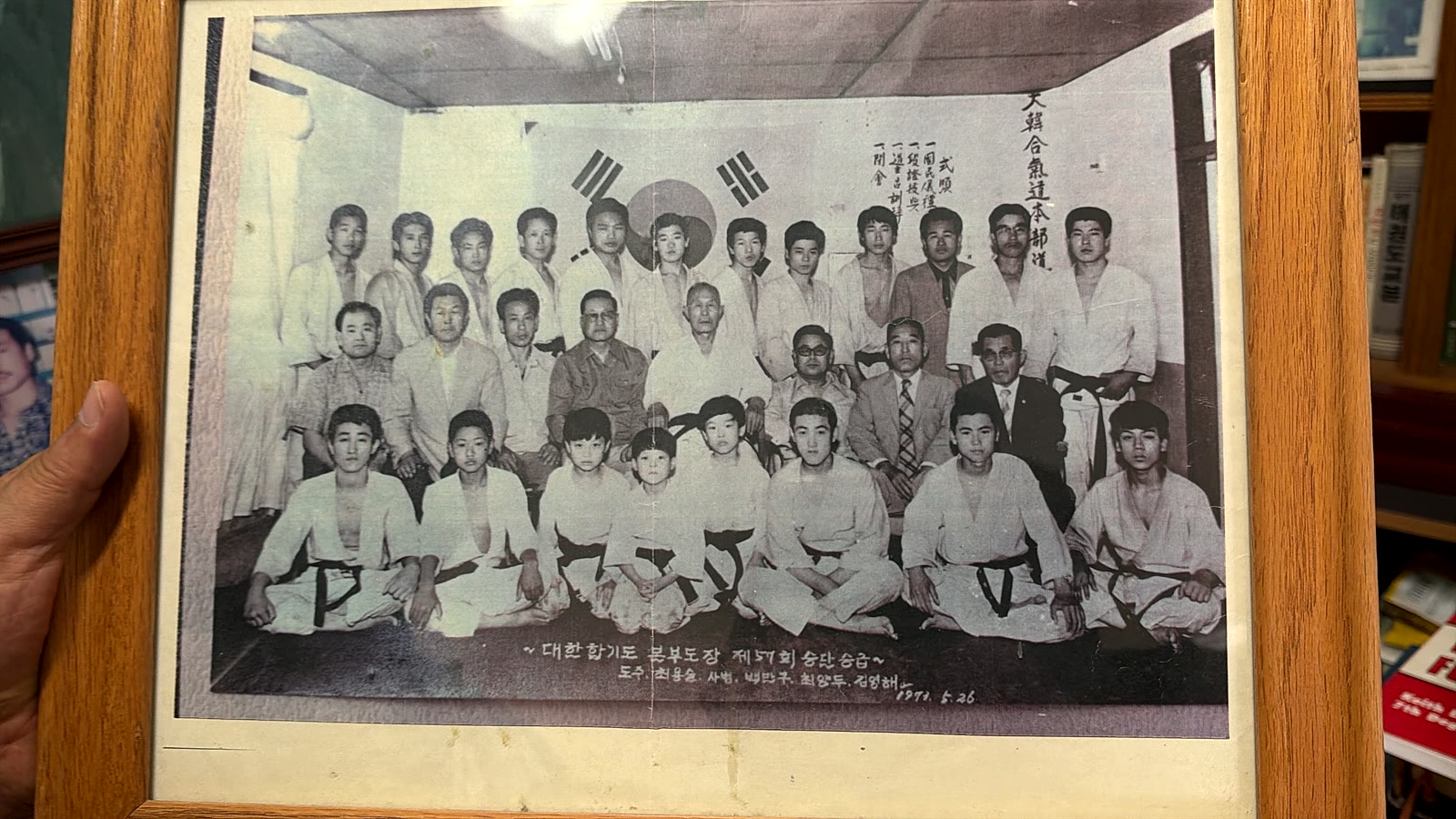
We teach both, which means you are not obliged to choose from a description. Our Hapkido instruction traces to training at the Korea Hapkido Headquarters Dojang from 1971, and we teach Taekwondo alongside it.
The practical recommendation: come and try a class in each. Thirty minutes of actually doing something tells you more than any comparison article, including this one. For a sense of how Korean arts sit relative to Japanese and Chinese ones, we compared them here.
KIMOO Martial Arts is at 2181 El Camino Real, Santa Clara, CA 95050. Your first class is free, and enrolling includes a uniform and white belt at no cost. Call (408) 243-1001 and tell us your age, any injuries and what you want from training — we will tell you honestly which to start with.
Frequently asked questions
What is the difference between Taekwondo and Hapkido?
Taekwondo is a striking art organised around extensive kicking, with forms, rule-based sparring and a competitive pathway. Hapkido redirects an attacker's force using joint locks, throws and leverage, focusing on close-range control and escapes from grabs. They share a country and little else.
Which is better for self-defence, Taekwondo or Hapkido?
Hapkido is the more direct answer, because most real altercations involve being grabbed or caught at close range rather than exchanging kicks at distance. Taekwondo still builds transferable attributes — timing, distance, commitment and fitness. No martial art makes anyone safe; awareness matters more than technique.
Which is better for children?
Usually Taekwondo. Forms and gradings provide the visible, sequential progress children respond to, and the physical demands suit how they like to move. Hapkido's joint work is generally better suited to older students for safety reasons.
Which is better for adults over 40?
Often Hapkido, especially with knee or hip history, because it relies on leverage rather than explosive flexibility and therefore ages well. Many adults train Taekwondo successfully into their fifties and beyond, so it depends on your joints and goals.
Can I train both Taekwondo and Hapkido?
Yes, and at a school teaching both you can try each before committing. They complement each other — striking at range and control at close quarters address different problems.
Does the style matter more than the school?
No. Variation between schools within a style is larger than variation between styles. A well-taught programme with small classes, real grading standards and individual correction beats a poorly taught one in any art. Judge the school first.
Where is KIMOO Martial Arts?
**2181 El Camino Real, Santa Clara, CA 95050.** Call **(408) 243-1001** to try a free class in either art.
Train with a champion
Book your free trial class at KIMOO Martial Arts in Santa Clara and train under a World Cup gold medalist.
Keep reading