Hapkido
Hapkido Joint Locks: How a Smaller Person Controls a Stronger One
The first time a Hapkido joint lock is applied to you properly, the surprising part is not the pain. It is how little the other person appears to be doing.
That is the entire design. Hapkido's stated philosophy is using minimal force to overcome a stronger opponent — which means great strength is not required to apply the techniques effectively. For anyone who is smaller, older, or simply not interested in a contest of muscle, this is the most practically interesting thing in Korean martial arts.
What a joint lock actually does
A joint has a range it travels through comfortably, and an end point. A lock takes the joint to that end point and applies pressure against it.
What makes it work is not force. It is leverage and geometry. Pressing against the joint is what creates the hold, and the discomfort it produces makes continued resistance an unattractive option — so the other person moves where you are directing them, because that is the direction that stops hurting.
Strength does not solve this problem, which is why a strong person's instinct to muscle out of a well-applied lock tends to make it worse rather than better.
The principles underneath
Hapkido rests on a small number of ideas, and they are worth understanding before any technique, because the techniques are only expressions of them.
- Non-resistance. You do not meet force with force. When someone pushes, you move with the push and redirect it. Blocking a stronger person head-on is a contest you lose.
- Circular motion. Hapkido moves in curves, not lines. A circle lets you change an attack's direction without stopping it, and it is what converts an opponent's momentum into something useful to you.
- The water principle. Water yields completely, takes the shape of whatever contains it, and is still unstoppable given time. Applied to movement, this means adapting continuously rather than committing to a fixed plan.
A student who understands these three can usually work out why a technique failed. A student who has only memorised the technique cannot.
The main categories
Most Hapkido curricula group wrist locks roughly into these families, though names and methods vary considerably between schools — Hapkido is not tightly standardised, and what one school calls a technique another calls something else entirely.
- Reverse wrist lock — the wrist is twisted back toward the forearm.
- Direct wrist lock — the wrist is pressed straight downward.
- Forward wrist lock — the wrist is torqued up toward the opponent's own face.
- Figure-four lock — a lock that controls the whole arm rather than the wrist alone, using the attacker's own limb for leverage.
Alongside these sit armbars, which control the elbow, and shoulder locks. In most curricula, basic outside wrist locks and armbars appear early, around yellow belt.
A deliberate note: those descriptions are categories, not instructions. Written descriptions of joint locks are close to useless for learning them, and that is not an accident of this article.
Why beginners start from a wrist grab
Almost every Hapkido student's first lock is taught from a static wrist grab — someone takes hold of your wrist, and you respond.
This gets criticised, reasonably. A static grab is not how most real confrontations begin, and a student who only ever practises against it has a narrow skill.
It persists for a sound reason, though. A static grab gives a beginner a fixed reference point while they learn the geometry of the lock. You cannot learn where a joint's end of range is while the limb is moving unpredictably. Once the shape is in the body, the same lock gets drilled from movement, from strikes, and from unpredictable entries.
The failure is not starting there. The failure is a school that stays there.
Why this cannot be learned from video
Two specific reasons, and they are both about safety.
The margin is narrow. A joint lock applied slightly too far, or at slightly the wrong angle, injures somebody. The line between control and damage is small and it is learned by feel, with an instructor adjusting your hands in real time. No video conveys the amount of pressure.
Both people need training. The person receiving the lock has to know how to move with it. Beginners who resist a throw or lock stiffly injure their own wrists — the damage frequently comes from the receiver fighting it rather than from the person applying it. Learning to receive safely is a taught skill, and it is why early practice is cooperative rather than competitive.
This is also why breakfall training comes early in Hapkido. Before you can be thrown safely, you learn to land.
Who this suits
Joint locks are the part of Hapkido that most appeals to people who are not large.
They are also largely standing, upper-body, low-velocity work, which makes them accessible to students who cannot do high kicks or jumping techniques for any reason. If you have read that martial arts requires athleticism you do not have, this is the part of the art that disagrees.
For the philosophy in more depth, the principles of flow, circle and harmony are covered here. For the self-defence application specifically, that is here.
Have one applied to you
Reading about this genuinely does not work. Twenty minutes of having a Grand Master take your wrist to the edge of its range, gently, explains more than any article.
Your first class is free, with no contract, and new students receive a free uniform and white belt. Call (408) 243-1001.
Learn it where it came from
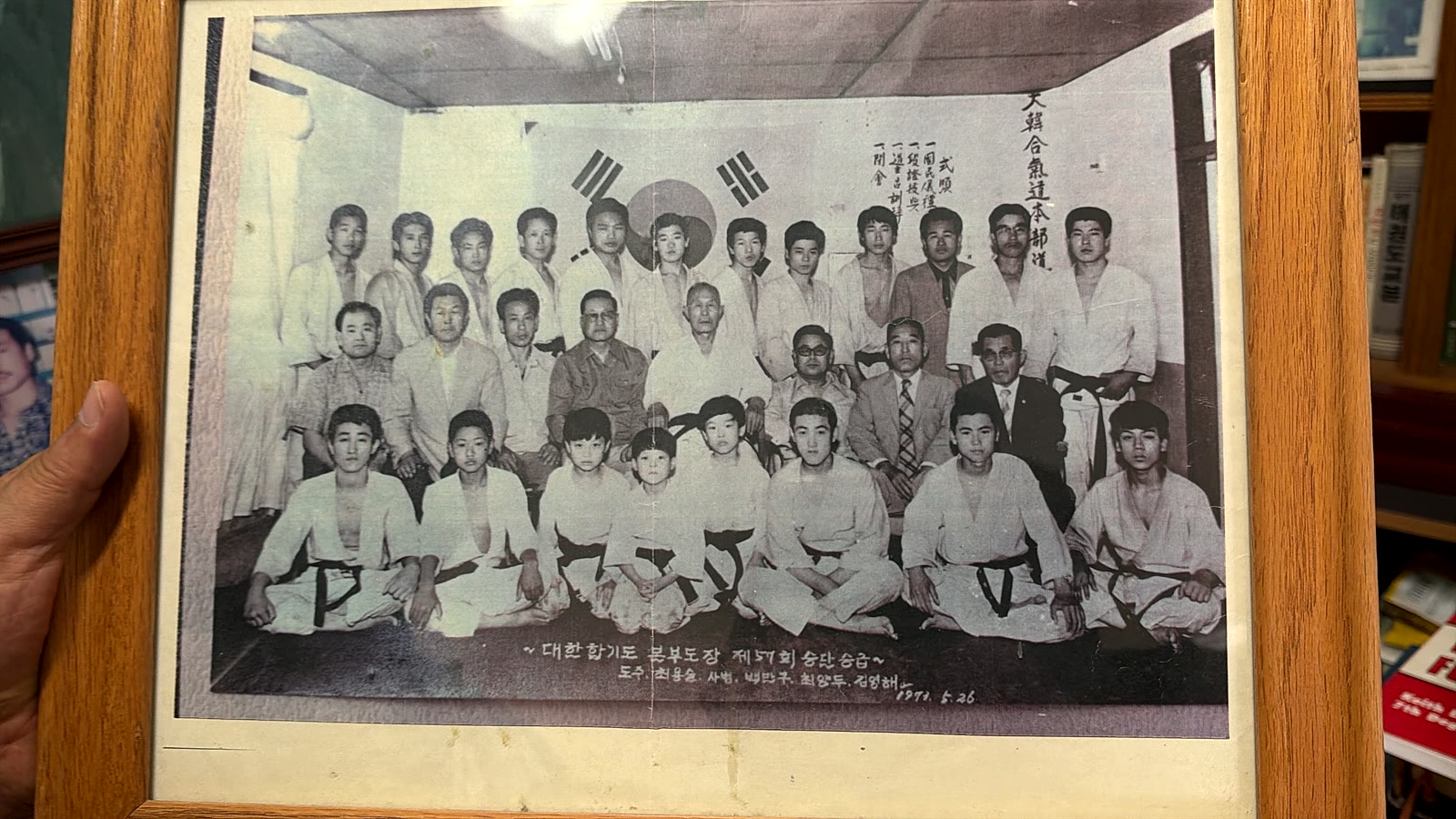
Grand Master Jong Yeon Hwang holds 8th Dan in Hapkido and trained at the Korea Hapkido Headquarters Dojang in 1971 — the birthplace of the art — under its founding grand masters. He was later decorated by the U.S. Army's 728th Military Police Battalion for training American and Korean soldiers in Korea.
Given how much Hapkido varies between schools, where your instructor learned it is not a trivia question.
Visit us: 2181 El Camino Real, Santa Clara, CA 95050
Frequently asked questions
How do Hapkido joint locks work without strength?
They use leverage and geometry rather than force. The lock takes a joint to the end of its range and applies pressure against it, making resistance unattractive, so the opponent moves in the direction you are directing them.
What are the main Hapkido principles?
Non-resistance, meaning you redirect force rather than meeting it; circular motion, which changes an attack's direction without stopping it; and the water principle of continuous adaptation.
Can a smaller person use joint locks against someone bigger?
That is specifically what they are designed for. Hapkido's philosophy is using minimal force to overcome a stronger opponent, and strength does not resolve a correctly applied lock.
Why do Hapkido classes start from a wrist grab?
A static grab gives beginners a fixed reference while they learn the geometry of a lock. Good schools progress to locks from movement and unpredictable entries; staying permanently on static grabs is the weakness.
Can I learn joint locks from videos?
Not safely. The margin between control and injury is narrow and learned by feel with hands-on correction, and the person receiving a lock needs training too — beginners most often injure their own wrists by resisting stiffly.
Are joint locks suitable if I cannot kick high?
Yes. They are largely standing, upper-body, low-velocity techniques, which makes them one of the more accessible parts of martial arts training.
Where is KIMOO Martial Arts in Santa Clara?
We are at 2181 El Camino Real, Santa Clara, CA 95050. Call (408) 243-1001.
Train with a champion
Book your free trial class at KIMOO Martial Arts in Santa Clara and train under a World Cup gold medalist.
Keep reading