Styles Explained
Taekwondo Hand Techniques: Punches, Knife Hands and Why They Matter
Ask anyone what Taekwondo is and they will mention kicks. Reasonable — the kicking is what the Korean tradition developed furthest.
Then you learn the first form and notice how much of it is hands.
The two words that split the system
Korean distinguishes between two kinds of hand technique, and the distinction is mechanical rather than cosmetic.
Jireugi (지르기) — a thrust or punch. The force travels in a straight line, driven from the hip and shoulder along the arm's axis. A piston.
Chigi (치기) — a strike. The force arrives along an arc, with the hand travelling on a curved path. A whip.
Nearly every hand technique is one or the other, and knowing which tells you where the power comes from. A thrust that is executed as a strike loses its drive; a strike performed as a thrust loses its speed.
The thrusting techniques
- Momtong jireugi — middle punch, to the torso. The foundational punch, and the one drilled most.
- Eolgul jireugi — high punch, to the face.
- Arae jireugi — low punch.
- Dubeon jireugi — double punch, two in rapid succession.
- Baro jireugi — punching with the hand on the same side as the forward leg.
- Bandae jireugi — punching with the opposite hand to the forward leg, which generates more hip rotation and more power.
That last pair is worth attention. The difference between baro and bandae is purely which hand throws relative to which leg is forward, and it changes the available power substantially. Beginners usually cannot feel the difference for several months, then suddenly can.
The striking techniques
These use parts of the hand other than the knuckles, which is where Taekwondo's hand work gets more distinctive.
- Sonnal chigi — knife-hand strike, using the outer edge of a flat open hand. The technique most associated with martial arts in popular imagination, and genuinely used.
- Sonnal mok chigi — knife-hand strike to the neck.
- Palkup chigi — elbow strike. Short range, high force, introduced around the fifth form.
- Mejumeok chigi — hammer-fist strike, using the bottom edge of a closed fist.
- Dungjumeok chigi — backfist strike, using the back of the knuckles on an arcing path.
Why hand technique matters in a kicking art
Four reasons, and they are practical rather than traditional.
Close range exists. A kick needs distance. When an opponent is inside kicking range, hands are what you have — and in a real confrontation, close range is where things usually happen.
It scores. In competition sparring, a punch to the body is worth a point, and matches are decided by single points often enough to matter. Punching to the head is not permitted in competition, which is worth knowing before you assume otherwise.
It teaches the body mechanics that make kicks work. Hip rotation, the pull-back hand, the connection between ground and fist — these are the same mechanics that power a kick, and they are much easier to learn and correct with a punch than with a leg in the air.
The forms are full of it. The early Taegeuk forms are built substantially around blocks and punches, with relatively few kicks. If you are learning the forms, you are spending most of your time on hand technique whether you intended to or not.
The three things beginners get wrong
Punching with the arm. The power comes from the ground, through the legs and hips, and arrives at the fist last. A punch thrown with only the arm is weak no matter how fast the arm moves. If your punches feel feeble, the problem is almost certainly your hips, not your shoulders.
Forgetting the pull-back hand. As one hand goes out, the other comes back to the hip. This is not symmetry for its own sake — the counter-rotation is a meaningful part of where the speed comes from.
Wrong wrist alignment. The wrist must be straight and the first two knuckles lead. A bent wrist at impact is how people hurt themselves, and it is the main reason good schools drill striking form extensively on pads before anything hard.
A related point on conditioning: hand strikes against resistance need to be built up gradually, which is the same principle that applies to board breaking. Nobody should be striking anything solid in their first month.
The rest of the vocabulary
Hand techniques complete the set of four families. The stances are here, the blocks are here, and the kicks are here.
For the Korean commands and counting that accompany all of it, start here.
Learn the mechanics properly
The hip connection is the part that transforms a punch, and it is almost impossible to self-diagnose. Someone has to watch you and tell you what is not rotating.
Your first class is free, with no contract, and new students receive a free uniform and white belt. Call (408) 243-1001.
Taught by a World Cup gold medalist
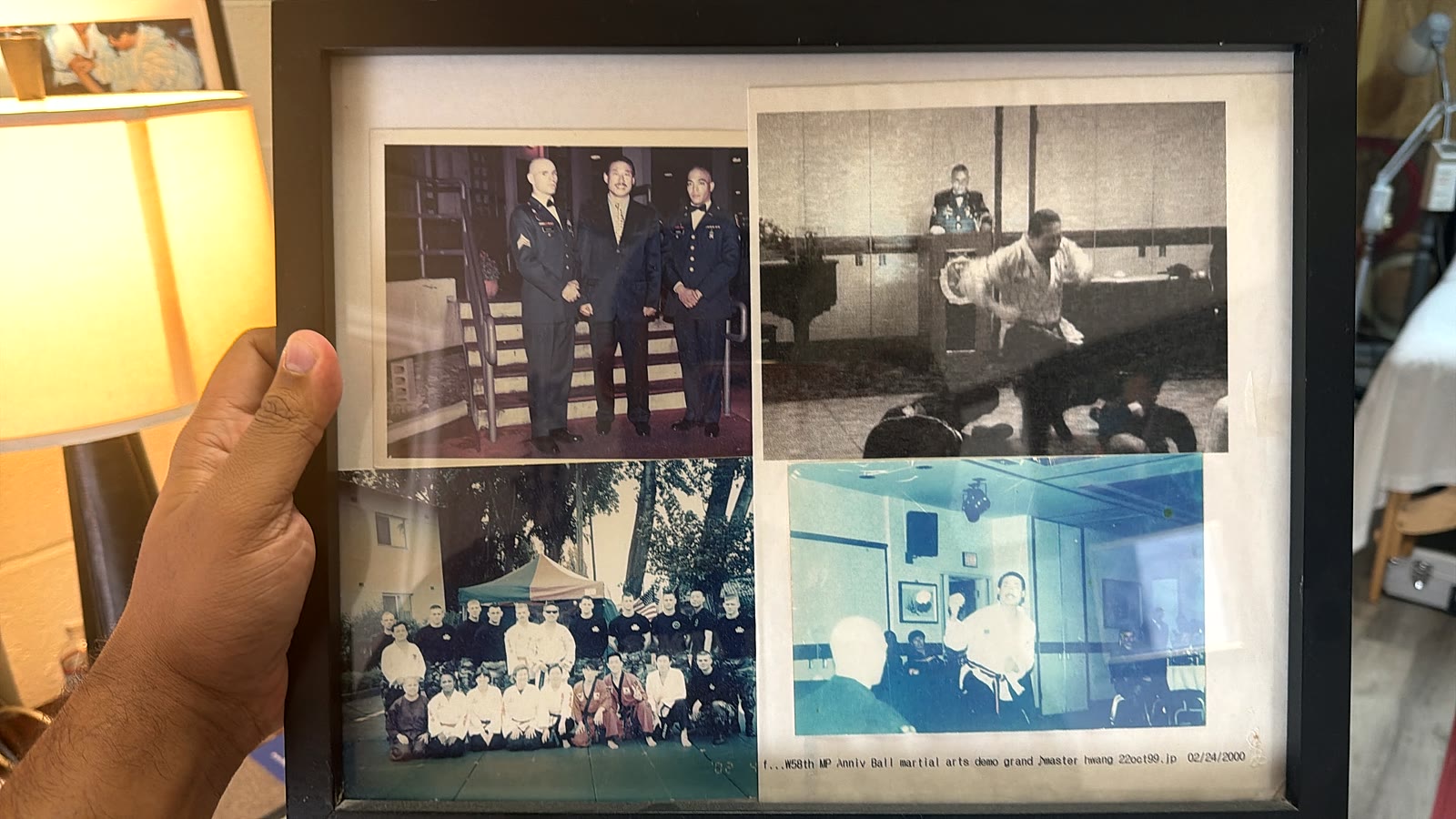
Grand Master Jong Yeon Hwang holds 8th Dan in Hapkido, trained at the Korea Hapkido Headquarters Dojang in 1971, and won gold at the 10th Wushu World Cup in Milan in 2005. Hand technique here is taught with the same seriousness as the kicking.
Visit us: 2181 El Camino Real, Santa Clara, CA 95050
Frequently asked questions
What is the difference between jireugi and chigi?
Jireugi is a thrust or punch, where force travels in a straight line driven from the hip and shoulder. Chigi is a strike, where the hand travels on a curved, whipping path. The distinction tells you where the power comes from.
What is the basic Taekwondo punch called?
Momtong jireugi, the middle punch to the torso. It is the foundational hand technique and the one drilled most often.
What is the difference between baro jireugi and bandae jireugi?
Baro jireugi punches with the hand on the same side as the forward leg; bandae jireugi uses the opposite hand, which allows more hip rotation and generates more power.
Does Taekwondo use punches in competition?
Yes, to the body, worth one point. Punching to the head is not permitted in competition sparring.
Why do my punches feel weak?
Almost always because the power is being generated by the arm rather than the ground, legs and hips. The fist is the last link in the chain, not the source.
What is a knife-hand strike?
Sonnal chigi — a strike using the outer edge of a flat, open hand rather than the knuckles. Sonnal mok chigi is the version directed at the neck.
Where is KIMOO Martial Arts in Santa Clara?
We are at 2181 El Camino Real, Santa Clara, CA 95050. Call (408) 243-1001.
Train with a champion
Book your free trial class at KIMOO Martial Arts in Santa Clara and train under a World Cup gold medalist.
Keep reading