Styles Explained
Taekwondo Blocks Explained: Makgi, the Three Heights, and the Knife Hand
Taekwondo block names sound like a long memorisation task. They are not. They are assembled from a small number of parts, and once you see the pattern you can decode blocks you have never been taught.
The naming system
Makgi (막기) means block. Every block name is makgi preceded by a height, a direction, or the part of the arm doing the work.
The three heights are the foundation:
- Arae (아래) — low, protecting the abdomen and below
- Momtong (몸통) — middle, protecting the torso
- Eolgul (얼굴) — high, protecting the face and head
And two directions:
- An (안) — inward, travelling across the body
- Bakkat (바깥) — outward, travelling away from the body
That is the whole grammar. Momtong an makgi is an inward block at middle height. Arae makgi is a low block. You can now read most block names on any syllabus.
A note on spelling, because it will confuse you otherwise: the high block appears as eolgul, olgul and olgil across different schools, and makgi is also written makki and mahki. These are the same words romanised differently, not different techniques.
The blocks beginners learn
In most schools these arrive in roughly this order:
- Arae makgi — low block. The forearm sweeps downward across the body to deflect an attack to the midsection or below. Usually the first block taught, and it appears in the very first form.
- Momtong an makgi — inward middle block. The forearm travels inward across the torso.
- Momtong bakkat makgi — outward middle block. The forearm travels outward, away from the centre line.
- Eolgul makgi — high block. The forearm rises to deflect a descending or head-height attack, forearm angled rather than flat.
- Sonnal makgi — knife-hand block. Uses the edge of the open hand rather than a closed fist.
The knife-hand family
Sonnal (손날) means knife hand — the hand held open and flat, blocking with the outer edge.
It modifies the same height-and-direction system, producing variants such as sonnal an makgi (inward knife-hand block), hansonnal bakkat makgi (single knife-hand outward block, where han means one, so only one hand is used), and sonnal arae makgi (knife-hand low block).
Knife-hand blocks typically arrive at the third form, which is where many students first meet both the knife hand and the back stance in the same technique — and discover that doing two unfamiliar things at once is harder than doing either.
A word on school variation
Beyond spelling, the techniques themselves differ. ITF schools teach some blocks that Kukkiwon schools do not, guarding blocks being a commonly cited example. Supported and cross blocks appear on some syllabuses and not others.
Detailed block lists online mostly come from individual school websites and fan wikis rather than from Kukkiwon, which is the authoritative naming body for World Taekwondo. So treat less common names as possibly school-specific, and learn the set your own school uses.
What a block actually does
Here is the thing that changes how you practise them.
A block is not a wall. Beginners treat blocking as putting a limb in the path of an attack and absorbing it, which against a stronger opponent is a losing proposition.
A block deflects and redirects. The angle of the forearm matters more than the force behind it — you are changing the attack's direction rather than stopping it. A correctly angled block takes very little strength. An incorrectly angled one requires a lot and still half fails.
Two practical consequences:
- The rotation is the technique. Most blocks involve forearm rotation at the moment of contact, which is what turns an impact into a deflection. Beginners leave the rotation out and wonder why it hurts.
- The non-blocking hand is doing something. In almost every basic block the other hand pulls back to the hip simultaneously. This is not decoration — it is the counter-rotation that generates the blocking arm's speed, and it is also the hand that is about to strike.
Which leads to the point instructors repeat endlessly: a block is the first half of a counter. If you are blocking and then thinking about what to do next, you are too slow. The pull-back hand is already loaded.
The rest of the vocabulary
Blocks are one of four technique families. The stances are here, the hand strikes are here, and the kicks are here.
Blocks appear constantly in the Taegeuk forms — in fact the early forms are largely a structured tour of these blocks at each height. For the commands and counting you will hear in class, that is here.
Learn the rotation in person
The forearm rotation is the part that genuinely cannot be learned from a diagram. It takes an instructor putting your arm in the right position a few dozen times.
Your first class is free, with no contract, and new students receive a free uniform and white belt. Call (408) 243-1001.
Taught where the lineage is real
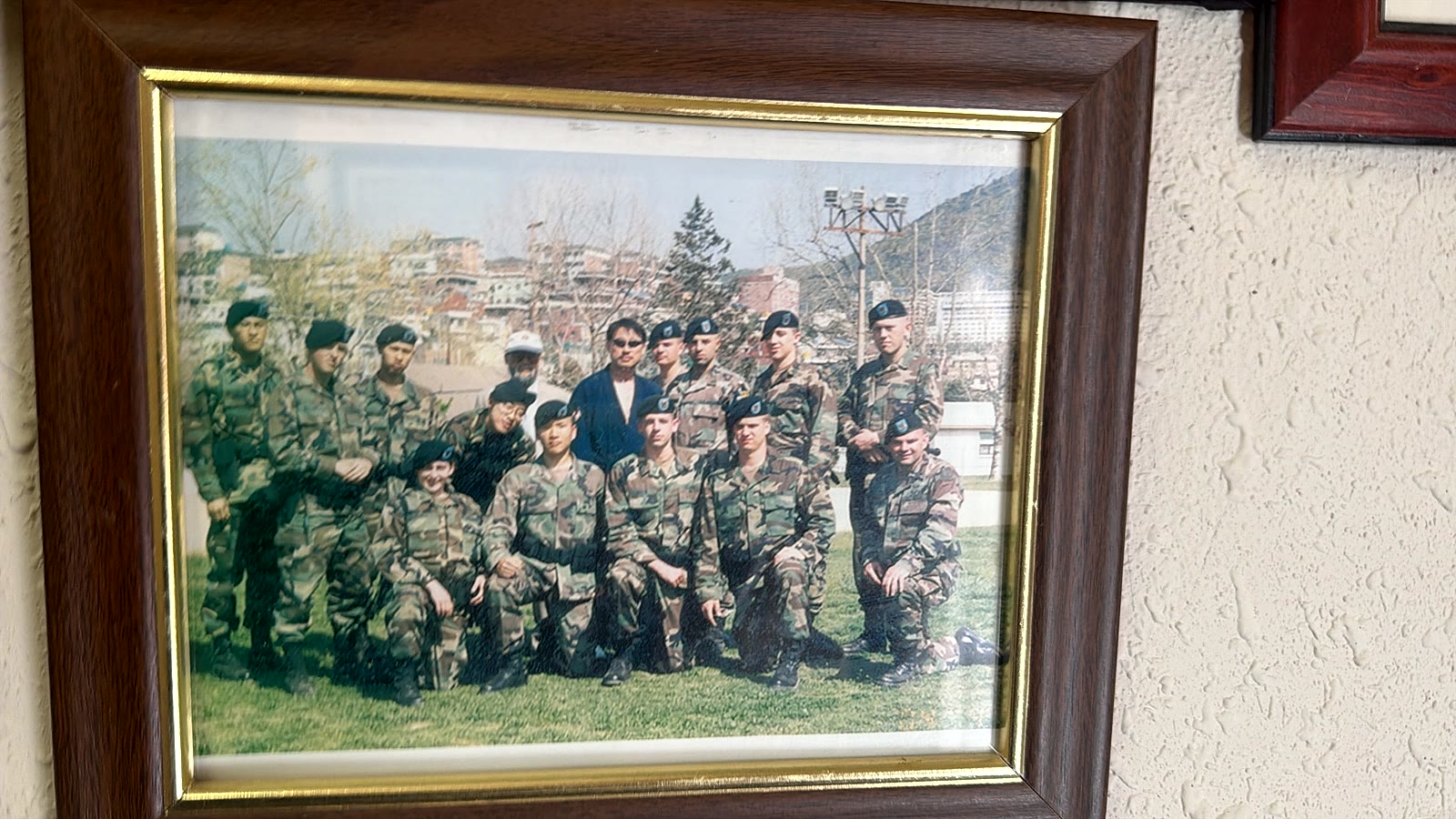
KIMOO is led by an 8th Dan Grand Master who trained at the Korea Hapkido Headquarters Dojang in 1971 under the founding grand masters of the art, and who was decorated by the U.S. Army's 728th Military Police Battalion for training American and Korean soldiers.
Visit us: 2181 El Camino Real, Santa Clara, CA 95050
Frequently asked questions
What does "makgi" mean?
Makgi means block. Block names are formed by adding a height, direction or hand position in front of it, so arae makgi is a low block and momtong an makgi is an inward middle block.
What are the three blocking heights in Taekwondo?
Arae (low, protecting the abdomen and below), momtong (middle, protecting the torso) and eolgul (high, protecting the face and head).
What is a knife-hand block?
Sonnal makgi — blocking with the outer edge of an open, flat hand rather than a closed fist. It modifies the same height and direction system, giving variants like sonnal an makgi and sonnal arae makgi.
What do "an" and "bakkat" mean?
An means inward, describing a block travelling across the body. Bakkat means outward, describing one travelling away from the centre line.
Why does my block hurt when I do it?
Usually because the forearm rotation has been left out, or the angle is wrong so you are absorbing the force rather than deflecting it. A correctly angled block requires very little strength.
Why is the other hand pulled back during a block?
It generates the counter-rotation that powers the blocking arm, and it loads the hand that is about to strike. A block is the first half of a counter, not a standalone defensive move.
Where is KIMOO Martial Arts in Santa Clara?
We are at 2181 El Camino Real, Santa Clara, CA 95050. Call (408) 243-1001.
Train with a champion
Book your free trial class at KIMOO Martial Arts in Santa Clara and train under a World Cup gold medalist.
Keep reading