Choosing a Dojo
How to Check Whether a Martial Arts Instructor's Rank Is Real
Here is a fact that surprises most parents: martial arts instruction is essentially unregulated. In most places there is no licence required, no governing body with legal authority, and nothing preventing someone from printing a certificate, buying a black belt and opening a school.
Most instructors are entirely legitimate. But the burden of checking falls on you, and almost nobody does it. Here is how.
Why belts and certificates prove little on their own
Belts can be bought. Anyone can buy a black belt with an embroidered organisation logo. The presence of a logo is a weak signal at best — treat it as supporting evidence, never as proof.
Certificates can be self-issued. A school can create its own organisation, name itself the governing body, and issue impressive-looking certificates in its own name. These are not forgeries exactly; they are real documents from a body that exists only to issue them.
"Master" and "Grand Master" are not protected titles. They carry genuine meaning inside established organisations, where they attach to specific ranks. Outside those, they mean whatever the person using them wants.
What real certification looks like in Taekwondo
For World Taekwondo-style Taekwondo, the authoritative body is the Kukkiwon in Seoul, which maintains the central register of Poom and Dan ranks.
A legitimately ranked Kukkiwon black belt has a Dan certificate with a registration number held in that central register. This is the thing that can actually be checked.
Kukkiwon introduced digital verification. A 2026 report describes a Kukkiwon Digital ID system that allows Poom and Dan certificates to be checked and authenticated via smartphone, using blockchain-based anti-tampering technology, real-time validity verification and QR codes, working both online and offline.
Two cautions on this. We could not confirm Kukkiwon's own verification page directly, so start at kukkiwon.or.kr rather than trusting a third-party tool. And be wary of any "verification" site not linked from Kukkiwon itself — a convincing-looking checker is exactly the kind of thing a dishonest school could set up.
In the United States, USA Taekwondo also maintains a Dan office and is a reasonable second point of reference.
Worth knowing: community discussion indicates Kukkiwon will accept transfers from other Kwan certificates only up to 3rd Dan, and that school-only black belt certificates are not recognised. Those are community sources rather than official statements, so verify directly, but they illustrate the general principle — a rank is meaningful because an external body recognises it.
Hapkido is genuinely different, and this is important
Here the picture is messier, and any honest article has to say so.
Hapkido has no single universally recognised governing body. There are several legitimate organisations, and the art is not tightly standardised — which is also why techniques and names vary considerably between Hapkido schools.
So "check them against the central register" does not work the same way. What matters instead is lineage: who taught this person, where, and when. A Hapkido instructor should be able to name their teacher and their teacher's teacher, and those names should be traceable.
This is not a loophole. It is how transmission in a less centralised art is actually verified, and a genuine instructor will answer lineage questions readily and in detail. Vagueness about who taught them is the warning sign.
What to ask, directly
These are reasonable questions and no legitimate instructor will be offended by them.
- What rank do you hold, in which art, and who certified it?
- May I see your certification? A real one will be shown without hesitation.
- What is the certificate's registration number, and which body holds the register?
- Who was your instructor, and where did you train?
- How long have you been teaching, and how long at this location?
- What continuing certification do you hold — first aid, CPR, child safeguarding?
That last one is worth as much as the rank for a children's class, and is far less often asked.
The warning signs
- Reluctance to show certification, or deflection into talking about experience instead
- An organisation that appears to exist only around this one school. Search the organisation's name independently.
- Rank that does not fit the timeline. Dan ranks have long minimum intervals — the common rule is that the wait in years matches the rank being tested for. Someone claiming 7th Dan at thirty-two years old is claiming something arithmetically difficult.
- Multiple high ranks in many different arts, all awarded quickly.
- Claims that cannot be checked — vague championships with no year, event or governing body.
- Hostility to the question. The reaction tells you more than the answer.
The thing that matters more than rank
An uncomfortable truth: a verified 6th Dan can be a poor teacher, and a 2nd Dan can be an excellent one. Rank certifies the person's own practice. It does not certify their ability to teach a seven-year-old.
So verify credentials — then watch a class, because that is where you learn whether they can actually teach. What to look for in a class is covered here, and the full set of questions to ask before enrolling is here.
Credentials are a filter, not the decision.
Our credentials, and how to check them
We would rather you asked, so here it is plainly.
Grand Master Jong Yeon Hwang holds 8th Dan in Hapkido. He trained at the Korea Hapkido Headquarters Dojang in 1971 — the birthplace of the art — under its founding grand masters. That is the lineage, and it is checkable.
Documented and externally verifiable:
- Gold, 10th Wushu World Cup, Milan, Italy, 2005 — a named event in a named year
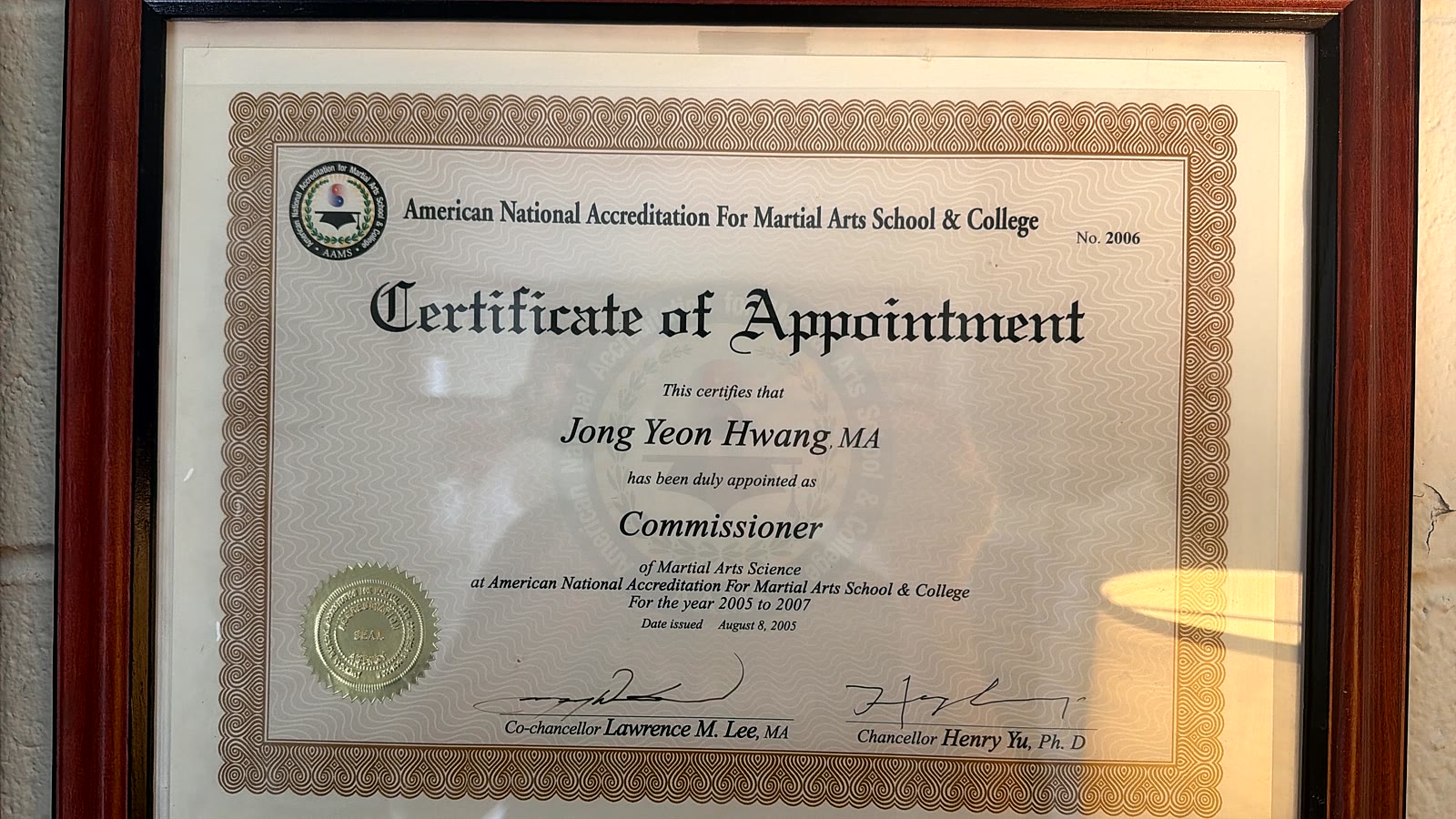
- Commissioner of Martial Arts Science, United States, 2005
- President's Volunteer Service Award (Gold), signed at the White House, 2023, for over 550 hours of service
- Decorated by the U.S. Army's 728th Military Police Battalion for training American and Korean soldiers in Korea
- City of Santa Clara District 2 Business of the Year, 2019
Every one of those names a specific body and year, which is precisely what makes a claim checkable rather than impressive-sounding. More on the academy's background is here.
Come in and ask to see the certificates. They are on the wall.
Your first class is free, with no contract, and new students receive a free uniform and white belt. Call (408) 243-1001.
Visit us: 2181 El Camino Real, Santa Clara, CA 95050
Frequently asked questions
Is martial arts instruction regulated?
Largely not. In most places no licence is required and no governing body has legal authority, so anyone can open a school and claim a rank. Verification is left to the student or parent.
How can I verify a Taekwondo black belt?
Kukkiwon maintains the central register of Poom and Dan ranks, and a legitimate Dan certificate carries a registration number held there. Kukkiwon has introduced a Digital ID system allowing certificates to be authenticated by smartphone with QR codes. Start at kukkiwon.or.kr rather than a third-party checker.
Does a black belt with an official logo prove certification?
No. Belts with organisation logos can be bought. Treat a logo as weak supporting evidence, never as proof of rank.
How do I check a Hapkido instructor's credentials?
Hapkido has no single universally recognised governing body, so central-register checks do not apply the same way. Ask about lineage instead: who taught them, where and when, and whether those names are traceable. A genuine instructor answers readily.
What are the warning signs of a fake instructor?
Reluctance to show certification, an organisation that exists only around their own school, rank inconsistent with the long minimum intervals between Dan grades, several high ranks in many arts awarded quickly, unverifiable championship claims, and hostility to being asked.
Is a higher-ranked instructor always better?
No. Rank certifies the instructor's own practice, not their ability to teach. Verify credentials as a filter, then watch a class to judge the teaching.
Where is KIMOO Martial Arts in Santa Clara?
We are at 2181 El Camino Real, Santa Clara, CA 95050. Call (408) 243-1001.
Train with a champion
Book your free trial class at KIMOO Martial Arts in Santa Clara and train under a World Cup gold medalist.
Keep reading