Styles Explained
Korean, Japanese and Chinese Martial Arts: What Actually Separates Them
Walk into three schools teaching Taekwondo, Karate and Kung Fu and you will see three visibly different things. Trace their histories and you find they are relatives.
Both facts are worth understanding, because the differences are real but shallower than the marketing suggests, and the similarities explain more than the differences do.
A caution before the generalisations. Each of these traditions contains dozens of styles that contradict any summary of it. "Chinese martial arts" covers both Tai Chi and Shaolin acrobatics. "Japanese martial arts" covers both Karate striking and Judo throwing. What follows are tendencies, and every one of them has prominent exceptions.
The shared root
The family resemblance is not accidental.
Karate developed in Okinawa, drawing on Chinese fighting methods alongside indigenous Ryukyuan practice. Taekwondo was assembled in twentieth-century Korea from older Korean arts with both Karate and Chinese influence in the mix. Chinese martial arts are the oldest of the three traditions, though sources disagree considerably on dating.
So the lineage runs broadly China to Okinawa to Japan, with Korea drawing on several of these at once while reasserting its own older practices. When a Karate block looks like a Taekwondo block, that is cousinhood, not coincidence.
Where they genuinely differ
Movement geometry. The most commonly cited distinction: Karate and Taekwondo rely largely on linear movement — direct lines, in and out, power generated front-to-back. Chinese arts tend toward the circular, with curved deflections and continuous redirection.
This is a real tendency and a useful starting intuition. It is also where the exceptions pile up fastest, since Korean Hapkido is built almost entirely on circular principles and sits firmly in the Korean tradition.
The kicking emphasis. This one holds up well. Taekwondo is distinctively kick-centred, with an emphasis on speed, agility and the use of the legs at a range and frequency the other traditions generally do not match. If you want to kick, the Korean tradition is where that was developed furthest.
Weapons. Chinese martial arts commonly include an extensive weapons curriculum — straight sword, broadsword, staff, spear and many more. Weapons are comparatively rare in modern Taekwondo and less central in most Karate.
Competition format. Taekwondo is an Olympic sport with full-contact point-based sparring and electronic scoring. Karate competition awards points for controlled strikes to defined target areas. Chinese Wushu competition is substantially a performance discipline, judged on execution and difficulty — closer in structure to gymnastics than to a bout.
Performance and acrobatics. Wushu openly incorporates acrobatic technique, which is why it photographs so well and why it reads to Western audiences as the most spectacular of the three.
What the differences do not tell you
Here is the part worth internalising if you are choosing: the style matters less than the school.
A well-taught Karate class and a well-taught Taekwondo class have more in common with each other than either has with a badly taught class in its own style. The instructor's competence, the class size, whether technique is corrected individually, and whether standards are real — these determine your experience far more than which country the art came from.
The generalisations above are useful for understanding what you are looking at. They are nearly useless as a decision procedure.
What we teach, and why all three
KIMOO is unusual in that the tradition question is not hypothetical here. Grand Master Hwang teaches across it.
- Hapkido — Korean, and a direct counterexample to "Korean means linear." Built on non-resistance, circular motion and joint control. The principles are here, and the joint-lock work specifically is here.
- Taekwondo — Korean, kick-centred, Olympic. The kicks and their Korean names are here.
- Wushu — Chinese, performance-oriented, and the art in which Grand Master Hwang won gold at the 10th Wushu World Cup in Milan in 2005. A beginner's guide to it is here.
That combination is the reason the comparison is worth writing rather than theorising about. Students here can train a Korean grappling art and a Chinese performance art under the same roof, and most discover the two inform each other.
If you want the narrower comparisons rather than the broad traditions: Hapkido versus Taekwondo, Karate versus Taekwondo, and Wushu versus Hapkido.
The better question
Instead of "which tradition is best," ask what you actually want.
- To kick well and perhaps compete — the Korean tradition, Taekwondo specifically.
- To control a larger person without striking — Hapkido, where the whole design assumes you are the smaller one.
- Athleticism, flexibility and performance — Wushu.
- Something you can sustain for twenty years — whichever school has the best teaching near you, which is a question about the school, not the country.
Come and try more than one
You do not have to decide from a web page. Watch a Hapkido class and a Wushu class and see which one you cannot stop thinking about on the drive home.
Your first class is free, with no contract, and new students receive a free uniform and white belt. Call (408) 243-1001.
One roof, two traditions, fifty years
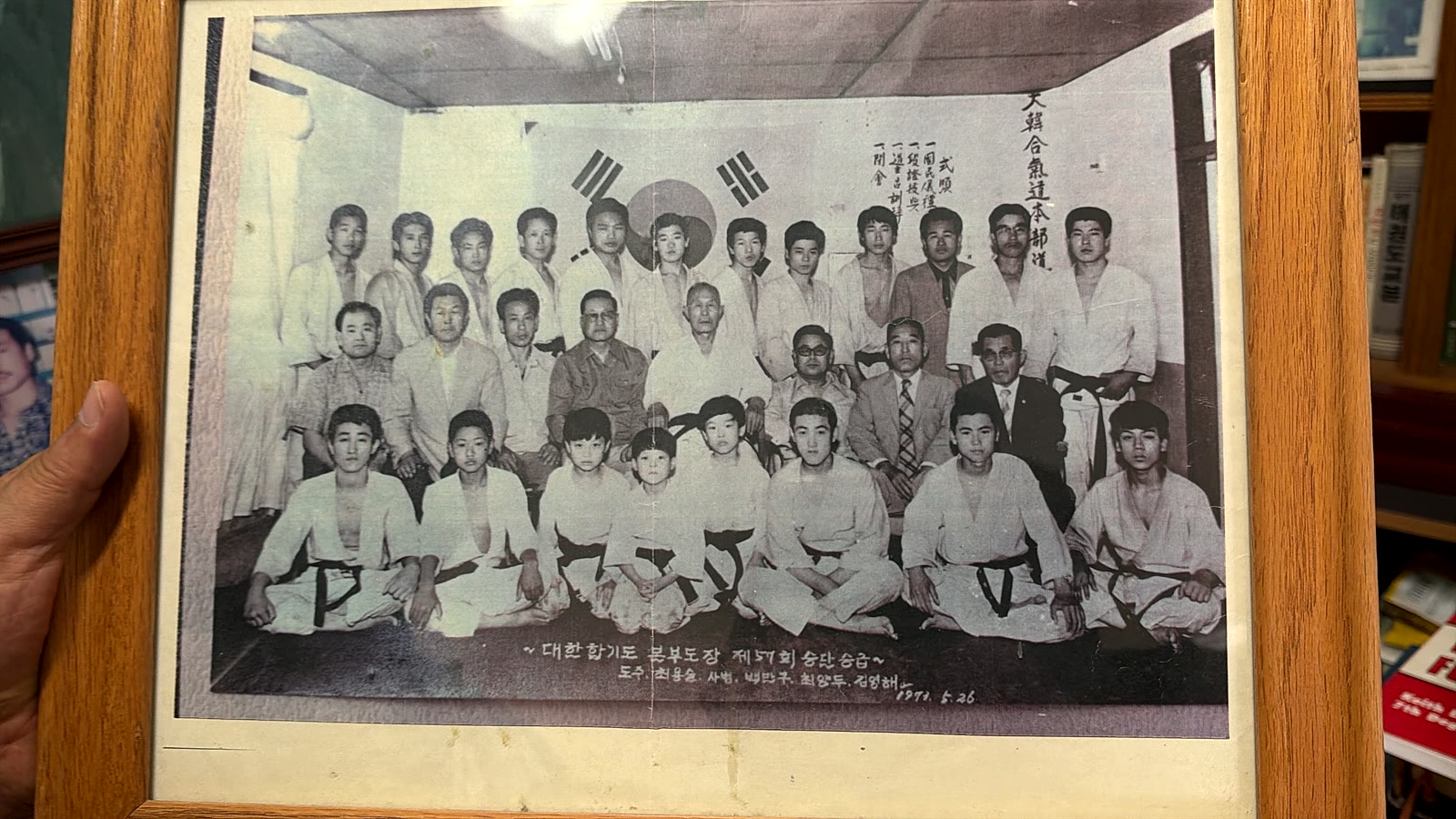
Grand Master Jong Yeon Hwang holds 8th Dan in Hapkido, trained at the Korea Hapkido Headquarters Dojang in 1971 under the founding grand masters, won Wushu World Cup gold in Milan, and was named Santa Clara District 2 Business of the Year in 2019.
Visit us: 2181 El Camino Real, Santa Clara, CA 95050
Frequently asked questions
What is the difference between Korean, Japanese and Chinese martial arts?
Broadly, Karate and Taekwondo favour linear movement while Chinese arts tend toward circular motion; Taekwondo is distinctively kick-focused; Chinese arts commonly include extensive weapons work. Every one of these tendencies has prominent exceptions.
Are Taekwondo and Karate related?
Yes. Karate developed in Okinawa with Chinese influence, and Taekwondo was assembled in twentieth-century Korea drawing on older Korean arts alongside Karate and Chinese influence. The visual similarities reflect shared lineage.
Which tradition has the best kicking?
The Korean tradition, and Taekwondo in particular, developed kicking furthest in terms of range, variety, speed and competitive emphasis.
Is Hapkido linear like Taekwondo?
No, and it is the clearest exception to that generalisation. Hapkido is Korean but built on circular motion, non-resistance and joint control rather than linear striking.
How does Wushu competition differ from Taekwondo competition?
Wushu competition is largely a judged performance discipline assessed on execution and difficulty, closer in structure to gymnastics. Taekwondo competition is full-contact point-based sparring with electronic scoring, and is an Olympic sport.
Which martial art should I choose?
The school matters more than the tradition. A well-taught class in any of these arts will serve you better than a poorly taught class in your theoretically ideal style.
Where is KIMOO Martial Arts in Santa Clara?
We are at 2181 El Camino Real, Santa Clara, CA 95050. Call (408) 243-1001.
Train with a champion
Book your free trial class at KIMOO Martial Arts in Santa Clara and train under a World Cup gold medalist.
Keep reading