Teens Program
Will Martial Arts Build Muscle? What Teenagers and Parents Should Know
A thin fifteen-year-old wants to get bigger. Or a parent wants to know whether martial arts will "build him up."
The honest answer involves biology that is rarely explained, and it changes what you should expect.
Puberty is the dividing line
This is the central fact and it clears up most of the confusion.
Before puberty, strength gains are mostly neural. A ten-year-old who trains gets genuinely stronger — but the improvement comes from better coordination, more efficient recruitment of muscle fibres and improved technique, not from muscles getting bigger. The reason is hormonal: pre-pubertal children lack sufficient circulating androgens for much hypertrophy.
After puberty, size becomes available. Training-induced strength gains in adolescent boys are associated with increases in fat-free mass driven by hormones including testosterone. One review puts it plainly: hypertrophy should not be a major goal of training programs for younger children, and only after a child has entered adolescence is it realistic to expect large gains in muscle mass.
Two caveats worth keeping. Maturation rates vary enormously — two fourteen-year-olds can be years apart developmentally, so this should be judged individually rather than by birthday. And newer reviews describe resistance training as safe and effective at all stages of childhood and adolescence, while noting the precise effect of puberty on the strength response is still not fully clear. Some of the older certainty here has softened.
So: a twelve-year-old who trains hard will get stronger and more capable, and will probably not get visibly bigger. A sixteen-year-old doing the same thing may well.
What martial arts actually builds
Being specific, because this is where expectations go wrong.
What it builds well:
- Relative strength — strength in proportion to bodyweight, which is what martial arts actually requires
- Core and hip strength, extensively, because every technique routes through them
- Explosive power and rate of force development
- Muscular endurance
- Legs, particularly from sustained low stance work — stance training is a genuine load on the quadriceps
What it builds less:
- Upper body mass. There is pushing and pulling in a martial arts class, but not the sustained progressive loading that drives chest, shoulder and back hypertrophy.
- Size generally, compared with dedicated resistance training
The reason is the stimulus. Hypertrophy responds to progressive mechanical load — moderate-to-heavy resistance, roughly 70 to 75 percent of a one-rep maximum for 10 to 12 repetitions, across multiple sets, sustained over twelve weeks or more. A martial arts class delivers high volume at low external load. That is excellent for skill, conditioning and relative strength, and it is not the hypertrophy stimulus.
So the direct answer: martial arts alone will not make a teenager noticeably bigger. It will make them stronger, faster, better conditioned and considerably more capable. If size is the specific goal, martial arts is not the tool.
What to do instead, or alongside
For a post-pubertal teenager who wants size, the sensible approach is martial arts for skill and conditioning plus structured resistance training for size.
The guidance on that resistance work:
- Twice a week on non-consecutive days, covering all major muscle groups
- Technique and execution first, before load
- Supervised. This matters — growth-plate fractures have been reported in adolescent lifters, and the risks in the literature attach to dropped weights and maximal lifts, not to resistance training itself. The growth-plate concern is widely misunderstood and we have covered the research in full.
- Progressive, meaning the load increases over time rather than staying comfortable
And the part teenagers consistently ignore: you cannot build tissue you are not feeding. A teenager eating at or below maintenance will not gain mass whatever they do in a gym. Nutrition for training is worth reading properly, and for a teenager trying to gain, total intake is the lever that matters most.
Combining the two does need load management. Martial arts three times a week plus heavy lifting twice a week is a real training load for a growing body, and recovery has to be planned rather than assumed.
The conversation worth having with a teenager
Two things are worth saying out loud, because the body-image pressure on teenage boys is substantial and mostly unspoken.
Size and capability are different things, and martial arts makes this unusually visible. Training rooms routinely contain a lean sixteen-year-old who can comfortably outperform a much larger one, because leverage, technique and conditioning beat mass at most things that are not a bench press. That is a useful thing for a teenager to see directly rather than be told.
Growth has its own timeline. A fifteen-year-old who has not developed yet is frequently comparing himself to peers eighteen months ahead developmentally, and concluding something is wrong with him. Usually nothing is. If there is real concern, that is a paediatrician conversation, not a gym one.
For the broader picture of fitting training around school pressure, that is here, and our teen program is described here.
Come and see what it actually does
Watch a teen class. You will see what the training produces, which is not bulk — it is speed, control and the ability to do difficult things with a body that cooperates.
Your teenager's first class is free, with no contract, and new students receive a free uniform and white belt. Call (408) 243-1001.
Taught by an 8th Dan
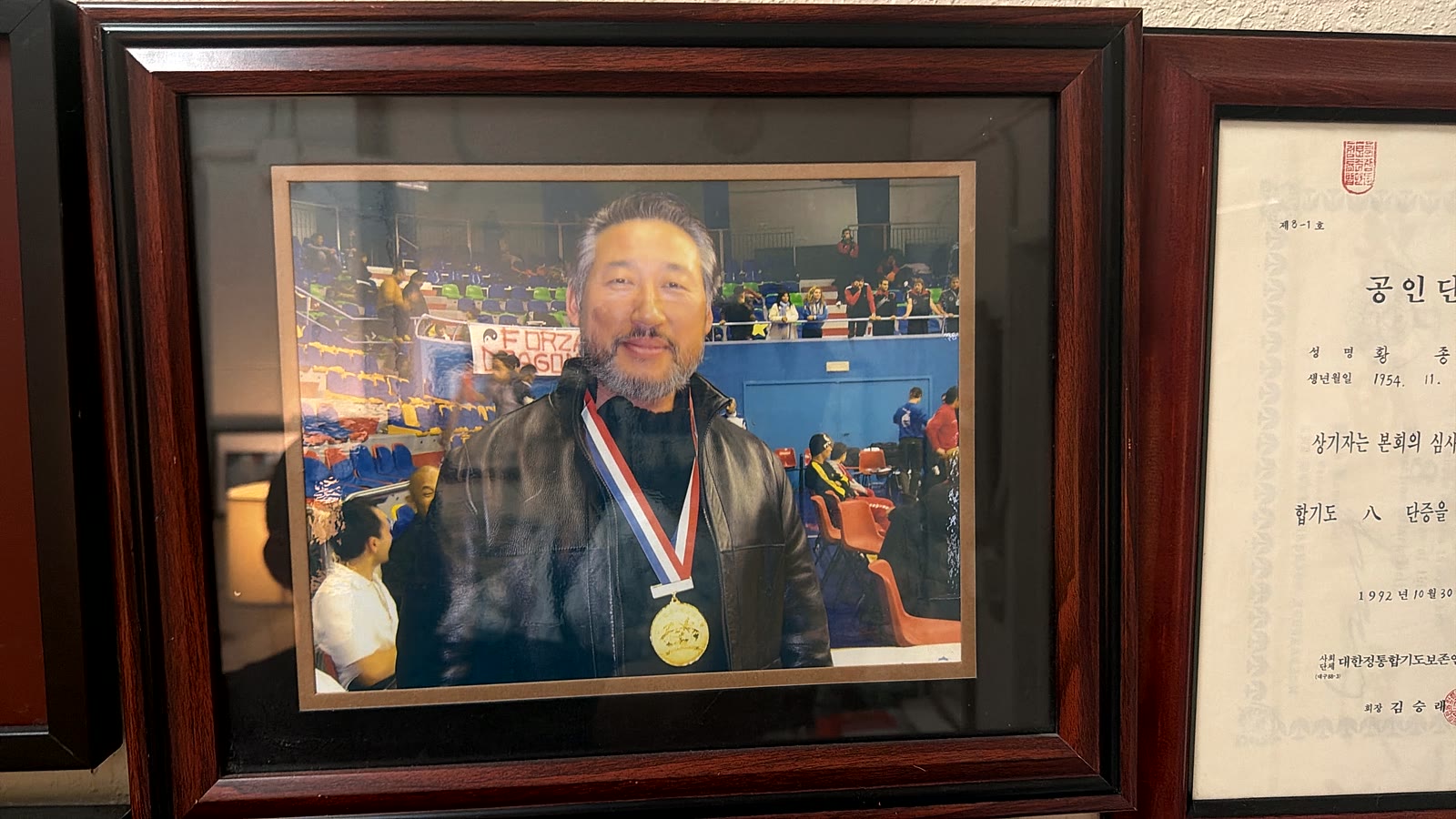
Grand Master Hwang trained at the Korea Hapkido Headquarters Dojang in 1971 and won Wushu World Cup gold in Milan. He has trained soldiers and national competitors, and will tell a teenager honestly what training will and will not do for them.
Visit us: 2181 El Camino Real, Santa Clara, CA 95050
Frequently asked questions
Does martial arts build muscle?
It builds relative strength, core and hip strength, explosive power and muscular endurance very well, and legs substantially through stance work. It does not provide the progressive mechanical load that drives visible size, particularly in the upper body.
Can a 12-year-old build muscle from training?
Not much visibly. Before puberty, strength gains come mainly from neural adaptations and better coordination, because children lack sufficient circulating androgens for significant hypertrophy. They will get genuinely stronger without getting bigger.
At what age can a teenager start gaining muscle mass?
Realistically after entering adolescence, when hormones including testosterone drive increases in fat-free mass. Maturation rates vary widely, so this should be judged individually rather than by age alone.
Is lifting weights safe for teenagers?
Reviews describe resistance training as safe and effective across childhood and adolescence when supervised, with technique prioritised over load. The reported risks attach to dropped weights and maximal lifts rather than to resistance training itself.
Should my teenager do martial arts or lift weights for size?
Both, if size is the goal: martial arts for skill and conditioning, plus structured resistance training twice weekly on non-consecutive days for hypertrophy. Martial arts alone will not add noticeable size.
Why is my teenager not gaining weight despite training?
Most often total food intake. Tissue cannot be built without eating above maintenance, and this is the factor teenagers most commonly overlook.
Where is KIMOO Martial Arts in Santa Clara?
We are at 2181 El Camino Real, Santa Clara, CA 95050. Call (408) 243-1001.
Train with a champion
Book your free trial class at KIMOO Martial Arts in Santa Clara and train under a World Cup gold medalist.
Keep reading