Black Belt Degrees Explained: What 1st Dan Through 9th Dan Actually Mean
November 7, 20267 min readKIMOO Martial Arts
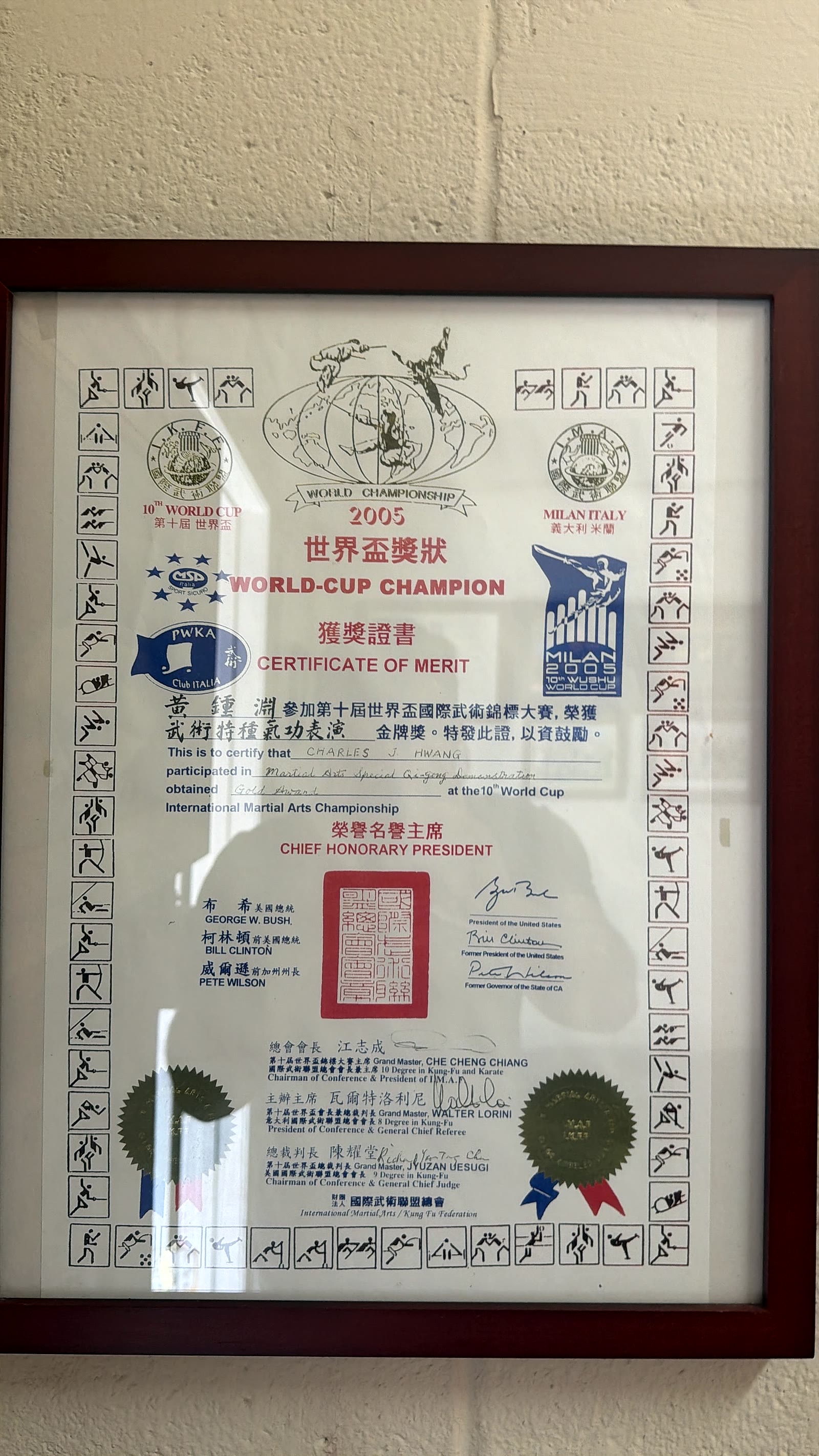
World Cup gold certificate awarded to Grand Master Hwang

Most people assume a black belt is the end of the ladder. In Taekwondo it is closer to the bottom of a second, much longer one.

Above black belt sit the Dan ranks, numbered first through ninth. Understanding them explains a lot about how martial arts schools actually work, and it tells you something useful about whoever is teaching your class.

Dan and Gup

Before black belt, students hold Gup (sometimes written kup) ranks, which count downward — a 1st Gup is the most senior coloured belt, immediately below black.

At black belt the counting flips and goes upward, from 1st Dan to 9th Dan. So the numbers getting bigger always means getting more senior, it is just that the direction reverses at black belt. This catches almost every beginner out.

What children hold instead

Here is a detail most parents have never been told: in Kukkiwon and World Taekwondo schools, students under 15 are awarded Poom ranks, not Dan ranks.

A child who passes the black belt test holds 1st Poom. The belt is often half red and half black rather than solid black. When they turn 15, the Poom rank converts to the equivalent Dan.

This is not a lesser achievement, and it is not a consolation prize. It recognises something sensible — that the physical and personal maturity expected of an adult black belt is genuinely different, and that a nine-year-old and a twenty-nine-year-old should not be measured against the same standard.

The waiting periods

This is the part that surprises people most. The gaps between Dan ranks are long, and they get longer.

The most widely used rule is that the wait in years equals the rank you are testing for. So a 1st Dan waits roughly two years before testing for 2nd Dan, a 2nd Dan waits three years before 3rd, and so on.

Follow that arithmetic and 9th Dan sits somewhere around four decades of continuous practice after first earning a black belt.

An honest caveat: the exact minimums vary by organisation, and published figures genuinely conflict. Some bodies use shorter waits at the lower Dans, and many attach minimum ages as well as minimum times. Anyone quoting you one universal table is oversimplifying. The pattern of lengthening intervals, though, is consistent everywhere.

Roughly what each tier means

Groupings differ between organisations, but the general shape is this:

  • 1st to 3rd Dan. A trained practitioner with sound fundamentals. Often permitted to assist in teaching. Competent, still developing.
  • 4th to 6th Dan. The instructor and expert tier. This is where teaching, not just performing, becomes the expectation. Earning 4th Dan is a serious milestone and typically takes well over a decade.
  • 7th to 9th Dan. Master and grandmaster ranks, usually carrying minimum age requirements as well as time. At this level, promotion rests on contribution to the art — students developed, organisations served, decades given — not on how high you can still kick.

A 10th Dan, where it exists at all, is generally honorary.

Why this is worth knowing before you choose a school

Because rank tells you what a school can actually teach you.

A school led by a 2nd Dan is not necessarily a bad school. But there is a real difference between learning from someone twelve years into their practice and learning from someone fifty years into it, and that difference compounds as you advance. The question worth asking is not only "is the instructor a black belt" but "how far ahead of me are they, and will they still be ahead of me in five years?"

It also sets expectations honestly. Earning a first black belt typically takes three to five years of consistent training — and that is the beginning of the Dan ladder, not the top of it.

If you want the coloured-belt side of the system first, the belt order and what each colour means is here.

Train under an 8th Dan

Grand Master Jong Yeon Hwang holds 8th Dan in Hapkido, which places him in the master tier — reached through decades of practice, teaching and service, not through a single test.

He trained at the Korea Hapkido Headquarters Dojang in 1971, under the founding grand masters of the art. He won gold at the 10th Wushu World Cup in Milan in 2005. He was decorated by the U.S. Army's 728th Military Police Battalion for training American and Korean soldiers, and received the President's Volunteer Service Award (Gold) at the White House in 2023.

He also still corrects stances personally, in ordinary classes.

Your first class is free, with no contract, and new students receive a free uniform and white belt. Call (408) 243-1001.

Visit us: 2181 El Camino Real, Santa Clara, CA 95050

Frequently asked questions

What does 8th Dan mean?

It is an eighth-degree black belt, within the master tier of the ranking system. Ranks at that level reflect decades of practice plus contribution to the art through teaching and service, and usually carry minimum age requirements.

How many degrees of black belt are there?

Nine tested Dan ranks, from 1st to 9th. A 10th Dan, where an organisation recognises one, is normally honorary.

Why does my child have a red and black belt instead of a solid black one?

Students under 15 in Kukkiwon and World Taekwondo schools are awarded Poom ranks rather than Dan ranks, often marked by a half-red, half-black belt. The rank converts to the equivalent Dan at age 15.

How long between black belt degrees?

The most common rule is that the wait in years matches the rank being tested for, so around two years to 2nd Dan and three more to 3rd Dan. Exact minimums vary by organisation and often include minimum ages.

Is a 1st Dan black belt an expert?

No, and the system does not pretend it is. A 1st Dan has solid fundamentals and has earned the right to begin serious study. Expertise is generally associated with 4th Dan and above.

Where is KIMOO Martial Arts in Santa Clara?

We are at 2181 El Camino Real, Santa Clara, CA 95050. Call (408) 243-1001.

Train with a champion

Book your free trial class at KIMOO Martial Arts in Santa Clara and train under a World Cup gold medalist.

Wushu Taijiquan Gold at Dakar 2026: What the Combined Event Means→Taekwondo Kicks: The Names, the Korean Terms and What Each One Is For→Can You Train Martial Arts With Bad Knees? What the Evidence Says→Keeping Martial Arts Going Over Winter Break in Santa Clara→Martial Arts as a Screen Time Alternative: What the 2026 Guidance Actually Says→Martial Arts Classes for Kids in Santa Clara: A Parent's Visit Checklist→Belt Stripes and Tips: What Those Little Tabs on Your Child's Belt Mean→Does Martial Arts Help Children Sleep Better? What the Research Actually Shows→How Long Until You See Results From Martial Arts? An Honest Timeline→Hapkido Joint Locks: How a Smaller Person Controls a Stronger One→Belt Test Nerves: How to Help Your Child Through Grading Day→What Actually Happens at a Belt Grading→Coming Back to Martial Arts After Years Away→What to Eat Around Training: A Practical Guide→Training With Glasses, Old Injuries or Physical Limits→Martial Arts vs a Gym Membership: An Honest Comparison→Nine Martial Arts Myths That Put People Off Starting→Giving Martial Arts as a Gift: An Honest Guide→Martial Arts for College Students in Santa Clara: A Practical Enrollment Guide→Martial Arts and Anxiety: Why a Dojang Helps When a Gym Does Not→How Long Does It Really Take to Get a Black Belt?→Dakar 2026 Wushu: What the Youth Olympic Competition Showed→Board Breaking: Why Martial Artists Do It, and How It Works→Wildfire Smoke and Martial Arts Training: An Air Quality Guide→Why Children Quit Martial Arts — and How to Stop It Happening→Training Martial Arts Alongside Your Child: Does It Work?→The Olympic Pathway in Taekwondo: How LA 2028 Qualification Works→Martial Arts for Weight Loss: The Realistic Numbers→The Dobok: Uniform Rules, Care and Dojang Etiquette Explained→Martial Arts for Desk Workers: An Antidote to Ten Hours Sitting→Karate vs Taekwondo: Which Should You Actually Choose?→Is Martial Arts Safe for Kids? The Injury Numbers, Compared→Girls in Martial Arts: What Parents Should Know→Your First Sparring Session: What It Is Really Like→Adult Beginner Martial Arts Classes in Santa Clara: A First-Step Guide→Youth Sports Heat Acclimatization: A Martial Arts Safety Guide→Women's Self-Defence: What Actually Works, and What Is Theatre→What Actually Happens in Your First Martial Arts Class→What Age Should a Child Start Martial Arts?→Taekwondo Belt Order: Every Colour and What It Means→Starting Martial Arts After 40: What Actually Changes→10 Questions to Ask a Martial Arts School (and 5 Red Flags)→Martial Arts vs Team Sports: Which Is Better for Your Child?→Martial Arts Classes for Friends in Santa Clara: What to Ask→What Do Martial Arts Classes Actually Cost in the Bay Area?→Martial Arts for Kids With ADHD or Autism: What the Research Says→Which Martial Art Is Actually Best for Self-Defence?→Wushu vs. Hapkido Classes in Santa Clara: How to Choose→Martial Arts Sparring and Concussion Safety: A Parent's Guide→Youth Martial Arts Classes in Santa Clara: A Parent's Safety Checklist→Martial Arts and Youth Physical Activity: A Parent's Practical Guide→Wushu Classes in Santa Clara: A Beginner's Guide for Families→Returning to Martial Arts After a Concussion: A Family Safety Guide→Can Martial Arts Count Toward Weekly Activity Goals? A Practical Guide→Kids Martial Arts Classes in Santa Clara for Individual Skill Growth→Women's Self-Defence in Santa Clara: Walk Anywhere, Fear Nothing→Why Santa Clara Families Choose KIMOO Martial Arts→Teen Martial Arts in Santa Clara: Strength With Purpose→Taekwondo in Santa Clara, Taught by a World Cup Gold Medalist→What the 2026 USA Taekwondo and AAU Alignment Means→Martial Arts Near Sunnyvale and Cupertino: Worth the Short Drive→Kids Martial Arts in Santa Clara: Free First Class, Free Uniform→Hapkido in Santa Clara: Learn It From the 1971 Source→A Beginner’s Guide to Hapkido Classes in Santa Clara→Competition Training in Santa Clara: Coached by a World Champion→The Road to Black Belt in Santa Clara — and Why It Cannot Be Bought→Adult Martial Arts in Santa Clara: Better Than Any Gym Membership→USA Taekwondo Poomsae Rules for 2026: A Family Guide→Sibling Martial Arts Classes in Santa Clara: What Families Should Ask→Teen Self-Defence Classes in Santa Clara: A Family's Guide→A New 2026 Adolescent Martial Arts Study: What It Can Tell Us→Martial Arts and DCD: What a 2026 Review Actually Found→Choosing Martial Arts Classes for Coordination in Santa Clara→Taekwondo Premier League Season 2: What the Hyderabad Format Means→Questions to Ask a Martial Arts Academy in Santa Clara Before Visiting→AI Movement Feedback in Martial Arts: What a 2026 Study Suggests→Hapkido Trial Class in Santa Clara: What to Ask Before You Book→Qatar Open Taekwondo 2026 Results: What the Oman Medal Story Shows→After a Martial Arts Trial Class in Santa Clara: How to Decide→Taekwondo 9th Dan Recognition in 2026: How to Read the News→Non-Competitive Martial Arts in Santa Clara: What to Ask→The 2026 School-Based Martial Arts Study: What It Says→Martial Arts Classes for Women in Santa Clara: How to Choose→Taekwondo Kicking Training in Santa Clara: What to Ask→Para Taekwondo at Asian Para Games 2026: Opening Results→2026 World Youth Karate Championships: How to Read the Results→Martial Arts Classes for First Responders in Santa Clara: What to Ask→Dakar 2026 Taekwondo: Dates and a Youth Olympic Storyline→After-School Martial Arts in Santa Clara: A Parent Checklist→Martial Arts Class Safety in Santa Clara: Questions to Ask→Martial Arts Aggression Research 2026: Reading the Evidence→Martial Arts Classes for Veterans in Santa Clara: What to Ask→Hapkido Principles of Flow, Circle, and Harmony: A Guide→Martial Arts Classes for Student Athletes in Santa Clara: What to Ask→Asian Games 2026 MMA Weight Rule: How a Draw Was Resolved→Taekwondo and Cultural Diplomacy: A Recent Kukkiwon Visit→Homeschool Martial Arts Classes in Santa Clara: Questions to Ask→Martial Arts Classes for Remote Workers in Santa Clara: What to Ask→3D-Printed Martial Arts Chest Protectors: A New Fit Concept→Martial Arts Classes for Healthcare Workers in Santa Clara: What to Ask→Kettlebell Training for Martial Artists: How to Start Thoughtfully→Taekwondo Tournament Spectator Etiquette: How to Cheer with Respect→Neurodivergent Students and Martial Arts in Santa Clara: What to Ask→Women's Taekwondo Classes in Santa Clara: What to Ask→Taekwondo Terminology for Beginners: Common Korean Class Words→Taekwondo Sport Anxiety Study: What Recent Injury Research Says→Multi-Style Martial Arts Classes in Santa Clara: A Choosing Guide→What to Wear to a Martial Arts Class in Santa Clara: Trial Guide→Poomsae vs Kyorugi: How Taekwondo Competition Formats Differ→Non-Contact Martial Arts Classes in Santa Clara: Questions to Ask→K41 vs K44 Para Taekwondo: How Classification Shapes Competition→Martial Arts Classes for Parents and Teens in Santa Clara: What to Ask→Hapkido vs Aikido: Key Differences and How to Compare Training→Taekwondo Change-of-Direction Testing: What a 2026 Review Found→Martial Arts Classes for Focus in Santa Clara: Questions to Ask→Martial Arts School Culture in Santa Clara: What to Look For→Kids World Open Taekwondo Championships 2026: What to Know→Self-Defence or Competition Training in Santa Clara: How to Choose→Martial Arts Practice at Home: A Focused Guide to Solo Training→World Taekwondo Grand Prix Paris 2026: Dates and Format→Martial Arts Classes for Introverts in Santa Clara: A First-Visit Guide→Martial Arts and Nonviolence: Training with Restraint→Changing Martial Arts Schools in Santa Clara: Questions to Ask→Martial Arts Flexibility Training: Build Range with Control→Accessible Martial Arts Classes in Santa Clara: What to Ask→Martial Arts Membership in Santa Clara: Questions Before You Join→Martial Arts and Bullying Prevention: A Responsible Guide for Families→Martial Arts Gear in Santa Clara: What to Ask Before You Buy→Hydration for Martial Arts Training: A Practical Guide→De-escalation and Self-Defence Training in Santa Clara: What to Ask→Martial Arts Training Journal: A Simple Post-Class Guide→Poomsae vs Kyorugi: Two Taekwondo Competition Formats→Martial Arts Class Size in Santa Clara: What to Ask→Virtual Taekwondo at Asian Games 2026: How It Works→Hapkido Instructor in Santa Clara: What Credentials Can Tell You→Martial Arts Training Plateau: How to Find a Productive Next Step→Hapkido Self-Defence in Santa Clara: Questions to Ask Before You Choose→Taekwondo at LA 2028: Events, Classes, and What to Know→Adult Taekwondo Classes in Santa Clara: How to Choose→Martial Arts and Cognitive Engagement: What Recent Research Says→Martial Arts Classes for Caregivers in Santa Clara: What to Consider→Open-Skill Martial Arts Training: Why Adaptability Matters→Martial Arts Classes for Teachers in Santa Clara: A Thoughtful Guide→Representative Martial Arts Training: A Practical Guide→Martial Arts Classes for Shift Workers in Santa Clara: What to Ask→Travel Safety Martial Arts Classes in Santa Clara: What to Ask→External Focus in Martial Arts Training: A Practical Guide→Kids Martial Arts Classes in Santa Clara: A Parent's Guide→Guided Discovery in Martial Arts Training: A Practical Guide→Martial Arts Resilience Training: Build a Steadier Practice→Martial Arts for Personal Safety in Santa Clara: What to Ask→Deliberate Practice in Martial Arts: A Smarter Way to Train→Adult Hapkido Training in Santa Clara: What to Ask→Private Martial Arts Lessons in Santa Clara: Questions to Ask→Ecological Dynamics in Martial Arts Training: A Practical Guide→Martial Arts Interoception: Learn to Notice Your Body→Martial Arts Classes for New Residents in Santa Clara→Martial Arts Social Connection: How Shared Practice Works→Martial Arts Classes for Seniors in Santa Clara: What to Ask→Martial Arts Classes for Parents in Santa Clara: A Practical Guide→Martial Arts Breakfall Training: Why Safe Falling Matters→Martial Arts Classes for Adults Returning to Exercise in Santa Clara→Embodied Martial Arts Training: Learn Through Movement→Martial Arts Prehab: A Smarter Way to Prepare for Training→How to Choose Martial Arts Classes for Runners in Santa Clara→Martial Arts Video Analysis: Use Recording with Purpose→How to Choose Martial Arts Classes for Tech Professionals in Santa Clara→Martial Arts Coaching Feedback: How to Improve with Purpose→How to Choose Martial Arts Classes for College Students in Santa Clara→Martial Arts Warm-Up Drills for Focused, Safer Practice→How to Choose Martial Arts Classes for Couples in Santa Clara→How to Choose Taekwondo Competition Training in Santa Clara→Augmented Reality Martial Arts Training: What Students Should Know→Martial Arts Peripheral Vision Training: A Practical Guide→How to Compare a Martial Arts Class Schedule in Santa Clara→How to Choose Self-Defence Classes for Beginners in Santa Clara→Martial Arts Distance Management: Train Position with Purpose→Martial Arts Training Load Management: Train with Purpose→How to Choose Martial Arts Classes Near Me in Santa Clara→Strength Training for Martial Artists: A Balanced Guide→How to Choose Martial Arts Classes Near Santa Clara→Martial Arts Training Apps: A Smart Guide for Students→How to Choose a Martial Arts Instructor in Santa Clara→Martial Arts Rhythm Training: Build Better Timing→Martial Arts Class Cost in Santa Clara: Questions to Ask→Martial Arts Skill Retention: How to Remember What You Learn→Back-to-School Martial Arts in Santa Clara: A Family Guide→Wearable Technology for Martial Arts: A Smart Training Guide→Martial Arts Belt Testing in Santa Clara: What to Ask→How to Choose Martial Arts Classes After Work in Santa Clara→Gamification in Martial Arts Training: Use Play with Purpose→Martial Arts Classes for Stress Relief in Santa Clara: How to Choose→AI Martial Arts Training in 2026: What Technology Can Do→Martial Arts Coordination Classes in Santa Clara: What to Look For→Constraint-Led Martial Arts Training: A Practical Introduction→Slow Martial Arts Practice: Why Precision Comes First→Martial Arts Training Goals in Santa Clara: Find Your Fit→Self-Defence Training for Commuters in Santa Clara→Martial Arts Situational Awareness: A Practical Training Guide→Martial Arts Decision-Making Under Pressure: Train the Process→Your First Martial Arts Class in Santa Clara: A Simple Guide→Martial Arts Footwork Training: Build Better Movement Habits→Martial Arts Classes for Teens in Santa Clara: A Parent's Guide→Martial Arts Training Recovery: A Smarter Way to Practise→Adult Martial Arts Training in Santa Clara: How to Choose Well→Martial Arts School Comparison in Santa Clara: A Practical Guide→Martial Arts Motor Learning: How Skills Become More Precise→Martial Arts Proprioception Training for Better Body Awareness→How to Choose a Korean Martial Arts Academy in Santa Clara→Martial Arts Self-Regulation: Train Attention with Purpose→How to Choose Martial Arts for Confidence in Santa Clara→Choosing Taekwondo Self-Defence Training in Santa Clara→Martial Arts Goal Setting for More Purposeful Training→How to Choose Taekwondo Fitness Training in Santa Clara→Martial Arts Mental Rehearsal for More Focused Practice→How to Choose Martial Arts for Fitness in Santa Clara→Martial Arts Cross-Training: How to Combine Skills with Purpose→How to Choose Women's Self-Defence Classes in Santa Clara→Martial Arts Injury Prevention: Safer, Smarter Training Habits→Martial Arts Etiquette for Beginners: A Practical Guide→Family Martial Arts in Santa Clara: How to Choose a Dojo→How to Choose a Martial Arts Trial Class in Santa Clara→Martial Arts Partner Drills: How to Train with Purpose→Martial Arts Forms Training: How to Practise with Purpose→Hapkido Classes in Santa Clara: A Guide for New Students→What to Look for in Taekwondo Classes in Santa Clara→Martial Arts Reaction Time Training: A Smarter Way to Practise→Martial Arts Breathing Techniques for Better Training→How to Find Beginner Martial Arts Training in Santa Clara→Martial Arts Mobility and Balance Training for Everyday Movement→How to Choose Competition Martial Arts Training in Santa Clara→How Martial Arts Builds Focus and Discipline→How to Choose Adult Self-Defence Classes in Santa Clara→Hapkido vs Taekwondo: Which Martial Art Is Right for You?→How to Choose the Best Martial Arts Dojo in Santa Clara→