Training Tips
How You Actually Learn a Form (and Why Repetition Alone Fails)
There is a finding in motor learning that is genuinely counterintuitive and badly under-used by people learning martial arts forms: the way of practising that makes you look best today tends to make you retain least.
It has a name — the contextual interference effect — and it has been studied for forty years. It is worth understanding, along with the substantial caveat that goes with it.
The two ways to practise
Blocked practice means doing one thing many times before moving on. Twenty front kicks, then twenty side kicks, then twenty turning kicks. Or running the first section of a form repeatedly until it is clean.
Random practice means interleaving. Front kick, turning kick, side kick, front kick, side kick, in unpredictable order. Or running the form from different starting points in varied sequence.
Blocked practice feels better. Performance within the session improves visibly, which is satisfying and reads as progress. Random practice feels worse — more errors, more hesitation, less visible improvement across the hour.
What the research shows
The effect was first meta-analysed by Brady in 2004, who reported a medium effect size favouring high contextual interference in laboratory research (Cohen's d = 0.57) and a negligible effect in applied research. That split has persisted and is the most important thing in this literature.
More recent work:
- A 2024 systematic review and meta-analysis by Czyż and colleagues examined transfer — whether a skill carries to a new variant or context — across 34 studies, finding a medium overall effect of SMD = 0.55 favouring random practice.
- A 2024 retention-specific meta-analysis pooled only delayed tests, administered at least 24 hours later, specifically because sleep-related consolidation affects results. It found random practice improved retention in laboratory settings, but that the benefit in applied settings was almost negligible. Effects were larger for older adults than younger ones.
- A 2024 meta-analysis in physical education described high-interference practice as hindering acquisition while producing more permanent retention gains.
- A dissenting result: Jiménez-Díaz and colleagues (2014) found both random and blocked practice produced significant performance effects with no significant difference between them.
So the honest summary is this: the effect is well established in the laboratory, consistently weaker in the field, clearest for transfer rather than pure retention, and not unanimous.
That is still useful, because transfer is exactly what a martial artist needs. A kick that only works from the one stance you drilled it from is not a skill you have.
What this changes about how to practise a form
Stop measuring a session by how it felt. The session where you made errors and had to think is frequently the one that produced learning. The session where everything flowed may have produced a good performance and little else. This is the single most useful reframe available.
Do not only run the form from the beginning. If you always start at move one, you learn the form as one long chain where each move is cued by the previous one. Break the chain deliberately: start from the middle, start from a section you find hard, run a section backwards through its sequence.
The diagnostic is simple. If you can only perform the form from the start, you have memorised a sequence rather than learned the movements.
Interleave the things you are tempted to separate. Practising three techniques in rotation feels messier than drilling each in turn. The evidence on transfer favours the messier version.
Separate learning the moves from polishing them. There is a legitimate place for blocked practice: the acquisition phase, when you do not yet know what the movement is. Twenty slow repetitions to install a new sequence is reasonable. It is after you know the shape that blocked practice stops paying and interleaving starts.
Space it out. Fifteen minutes on four days beats an hour on one. This is a separate and better-established finding than contextual interference, and it is the one most people violate hardest — the night-before-grading session is the least efficient possible use of an hour.
Sleep between practice and performance. The retention meta-analysis deliberately pooled only delayed tests because of consolidation effects. We wrote about what that research does and does not support in sleep and recovery for martial artists, including the 2008 analysis arguing the overnight improvement effect may partly be a statistical artefact.
Where attention should point
A related and separate line of research concerns what you focus on while moving. The short version is that directing attention to the effect of a movement — where the foot lands, what the strike does — generally produces better learning than directing it to the body part producing it. We covered that in external focus in martial arts training.
The practical combination of the two findings: interleave what you practise, and think about the target rather than your hip.
What this does not mean
It does not mean repetition is worthless. You cannot interleave something you cannot do at all, and volume remains how movement becomes automatic. Our article on forms training covers why forms exist in the syllabus in the first place.
It also does not mean you should restructure your classes. A competent instructor is already varying practice structure, and the field-versus-laboratory gap in this literature is a reason for modesty about applying it too aggressively. The finding is most actionable in your own practice between classes, which is where most people default to the least effective structure — running the form from the top, over and over, on the day before the grading.
If you train at home, how to practise martial arts at home covers the rest of it, including why unsupervised repetition of a flawed movement is actively harmful.
At KIMOO
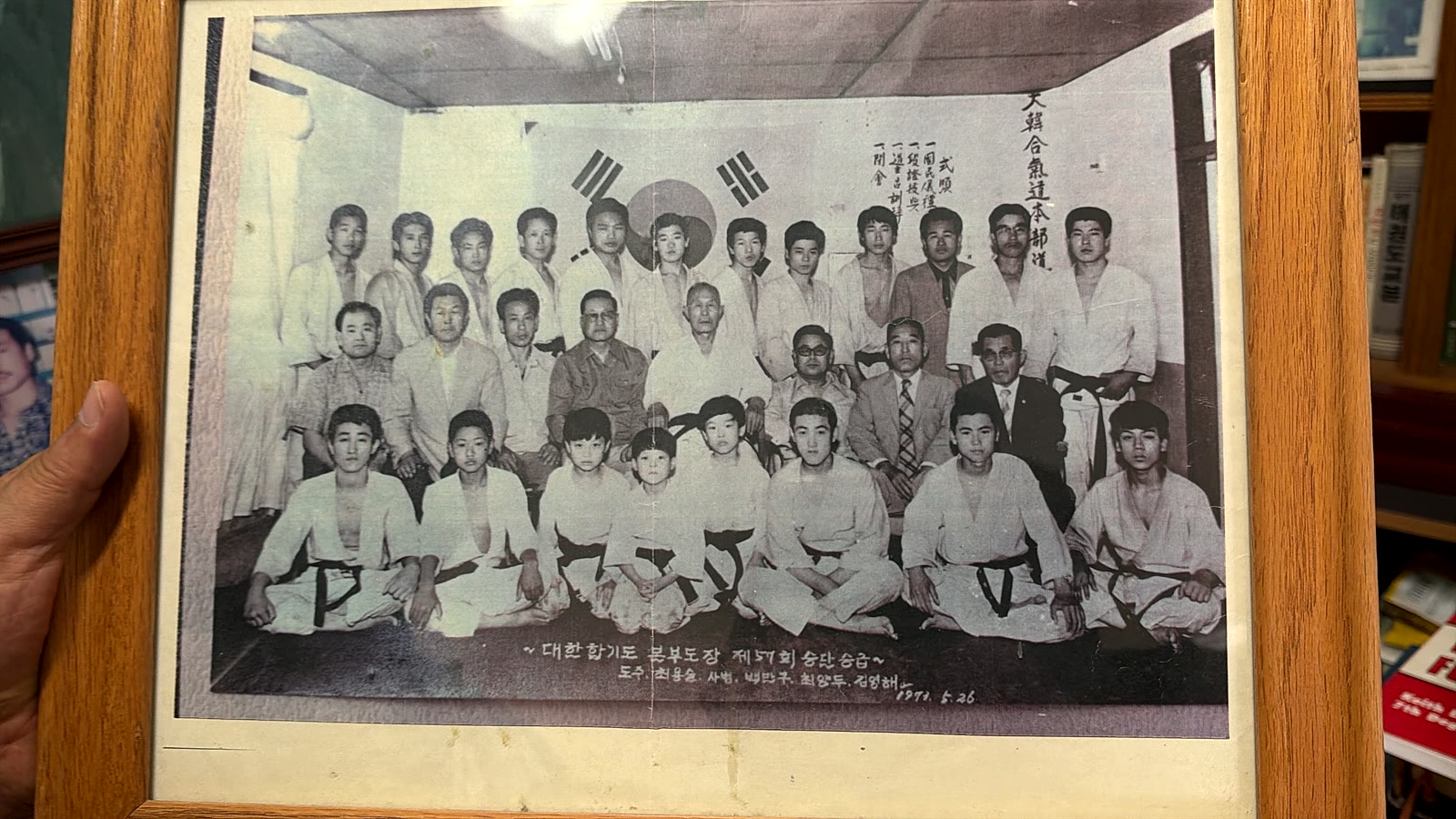
We teach Taekwondo and Hapkido in Santa Clara at 2181 El Camino Real, Santa Clara, CA 95050, under a Grand Master certified 8th Dan in Hapkido who trained at the Korea Hapkido Headquarters Dojang under its founding grand masters, and who was decorated by the U.S. Army's 728th Military Police Battalion for training American and Korean soldiers.
Instruction is where this material actually matters, because the most important variable in your learning is whether someone is correcting what you cannot see. Call (408) 243-1001 for class times and to book a free trial class.
Frequently asked questions
What is the fastest way to learn a martial arts form?
Not repeating it from the beginning. Research on contextual interference finds that varied, interleaved practice produces better transfer than blocked repetition — a 2024 meta-analysis of 34 studies found a medium effect (SMD = 0.55) favouring random practice for transfer. Practise sections out of order, from different starting points, spread across several short sessions.
Why does my form fall apart when I start from the middle?
Because you learned it as a chain in which each move is cued by the previous one, rather than learning the movements themselves. This is the standard consequence of only ever practising from move one, and it is the clearest diagnostic that memorisation has substituted for learning.
Is blocked practice useless?
No. It has a legitimate place in the acquisition phase, when you do not yet know what the movement is — slow repetition to install a new sequence is reasonable. The evidence turns against it once you know the shape of the movement and are trying to retain and transfer it.
Is it better to practise an hour once a week or fifteen minutes four times?
Four short sessions, by a clear margin. Distributed practice is a better-established finding than contextual interference, and the single long session before a grading is close to the least efficient possible structure.
Why does the practice that feels worse work better?
Because within-session performance and long-term retention are different things. Blocked practice improves performance inside the session, which feels like learning. Interleaved practice produces more errors during the session and better retention and transfer afterwards. Judging a session by how it felt systematically misleads.
Does this research definitely apply to martial arts?
Partly, and we would not overstate it. The effect is robust in laboratory settings and consistently weaker in applied ones — Brady's 2004 meta-analysis found a medium laboratory effect and a negligible applied effect, and a 2024 retention meta-analysis reproduced that split. The transfer findings are the most relevant, since transfer is what martial artists need.
Where can I learn Taekwondo forms in Santa Clara?
KIMOO Martial Arts, **2181 El Camino Real, Santa Clara, CA 95050**. Call **(408) 243-1001** for class times and to book a free trial class. New students receive a free uniform and white belt on enrolment.
Train with a champion
Book your free trial class at KIMOO Martial Arts in Santa Clara and train under a World Cup gold medalist.
Keep reading