Adult Program
Starting Martial Arts After 40: What Actually Changes
The question behind "am I too old?" is usually "will I embarrass myself?"
The answer to the second is no, and the answer to the first is almost certainly no as well. But let us be honest about what does change.
What genuinely changes
- Recovery takes longer. This is the real difference. At twenty you train through soreness; at forty-five you train around it. Two or three sessions a week with rest between beats five sessions and an injury.
- Flexibility starts lower. It improves — often dramatically — but from a lower baseline and more slowly. Head-height kicks may never be your technique, and they do not need to be.
- Old injuries matter. A knee from your twenties is now a planning constraint. Tell your instructor on day one, not after it flares.
What does not change
- Your ability to learn technique. Skill acquisition does not fall off a cliff at forty.
- Your ability to earn rank. Adults progress through the same standards.
- Your ability to defend yourself. Leverage-based arts like Hapkido are designed around not needing to be the strongest person present.
Why older beginners often progress faster
This surprises people, but it is consistent.
- You listen better. A correction given once is usually applied. That alone doubles the value of each session.
- You practise deliberately. Adults work on the thing they are bad at. Teenagers tend to repeat what they are already good at.
- You understand why. When an instructor explains the mechanical principle behind a joint lock, you can generalise it rather than just copying it.
- You turn up. Consistency beats talent over any timeframe that matters, and adults who choose to be there are consistent.
Training without wrecking yourself
- Tell your instructor everything about previous injuries before your first class.
- Go to technique, not exhaustion. The goal is a correct movement, not a survived session.
- Two or three sessions a week, with recovery days between. More is not better at this stage.
- Stop when something is sharp. Dull ache is adaptation. Sharp is information.
- Skip the ego. The eighteen-year-old is faster. They will also still be a white belt in technique while you are building rank.
The long view
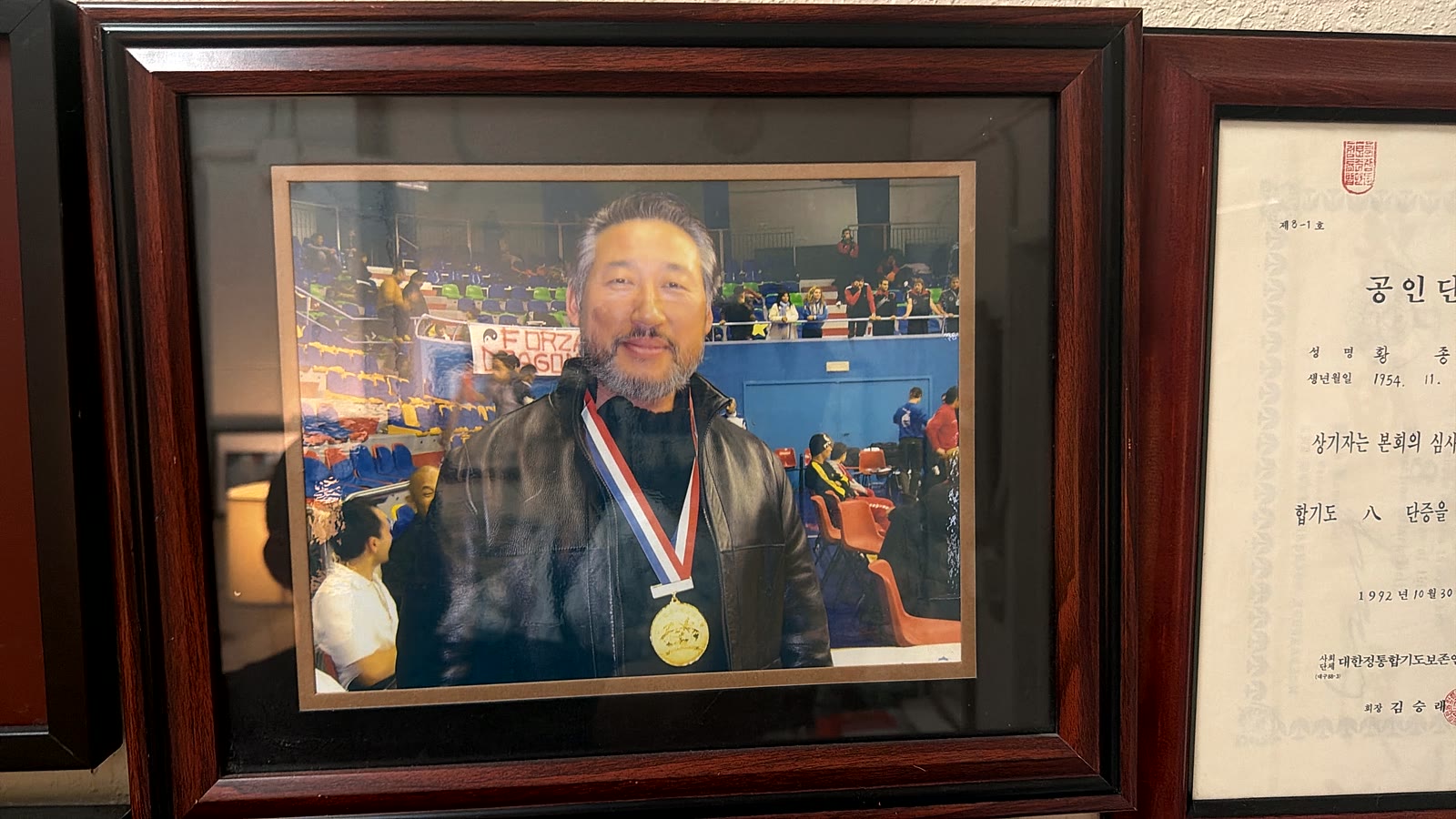
Grand Master Hwang began training in 1971 and still teaches on the mat personally, holding 8th Dan certification. Martial arts is one of the very few physical disciplines you can genuinely start in middle age and still be doing in thirty years.
That is not true of most sports people take up at forty.
If you are weighing which art suits you, we compared them honestly here, and the adult program is described in full here.
Try one class and find out
No contract, no equipment, no pressure, and nobody watching you except an instructor whose job is to correct you kindly. Your first class is free, and new students receive a free uniform and white belt.
Call (408) 243-1001 and mention any injuries when you book.
Train where the standard is real
You are corrected personally by an 8th Dan Grand Master who has trained for over fifty years and understands exactly how to scale training to the person in front of him.
Visit us: 2181 El Camino Real, Santa Clara, CA 95050
Frequently asked questions
Am I too old to start martial arts at 40?
No. Recovery is slower and flexibility starts lower, but learning capacity and the ability to earn rank are unaffected. Many adults start in their forties and fifties.
Can I start martial arts at 50 with no experience?
Yes. Most adult beginners have no experience, and classes scale to the individual.
How often should an older beginner train?
Two to three sessions a week with recovery days between is usually more productive than training daily.
What if I have old injuries?
Tell your instructor before your first class so training can be adapted. This is routine and expected.
Which martial art is best for older beginners?
Leverage-based arts such as Hapkido suit older students well, because they rely on technique and angle rather than strength or speed.
Where is KIMOO Martial Arts in Santa Clara?
We are at 2181 El Camino Real, Santa Clara, CA 95050. Call (408) 243-1001.
Train with a champion
Book your free trial class at KIMOO Martial Arts in Santa Clara and train under a World Cup gold medalist.
Keep reading